The Mediator's Exhaustion
There is a person in every group who seems to be from everywhere on the map at once - and the framework's notes about what that costs are the most brutal in the document.

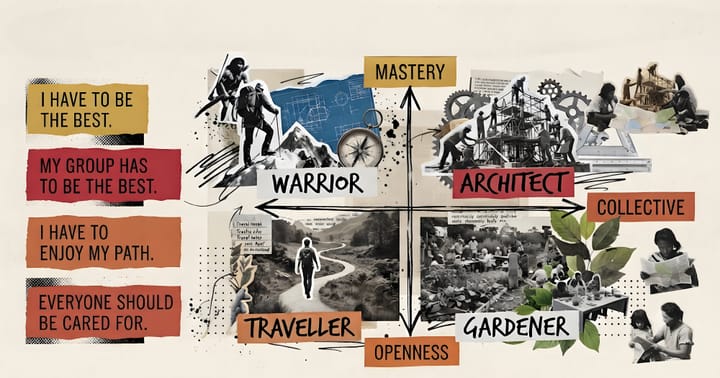
There is a person in almost every group who seems to be from everywhere on the map at once. They argue fiercely for individual excellence and defend the team's collective claim in the same meeting. They drive hard on outcomes and genuinely savour the unproductive conversation afterwards. Psychometricians call this a flat profile. The framework calls it the Mediator - the person who holds opposite ends of both value dimensions at once - and its notes about what that costs are the most brutal in the document.
The shadow list, quoted almost verbatim: swayer. Fickle-minded. Unreliable. Indecisive. Chanchal. The list is brutal because it is accurate from the outside, and the tragedy of the Mediator is that every word on it is a fair description of what the integration looks like from where the observers sit. A person who genuinely holds both ends of a dimension does not answer questions the way a person with one answer does. Asked "is speed or quality more important?", the single-ended person answers; the Mediator answers "it depends" - which is wisdom, and is also, on any given Tuesday, indistinguishable from having no answer at all.
The framework's claim is that integration looks like wisdom from outside and exhaustion from inside, and that this is the honest trade. Consider what the Mediator is actually doing in the meeting: running both poles at full resolution simultaneously. Where the Warrior filters the world through "how do we win," the Mediator runs "how do we win" and "who is harmed" and "what is being lost" and "what does the group need" in the same pass. That is not double the work of a single pole. It is a different order of magnitude - and the fatigue the Mediator carries home is not weakness but the bill for the parallel processing.
The world's traditions, it turns out, mostly reserve their highest words for this condition - and their patience for the people in it is greater than the world's. The traditions call the Mediator's state integration, and they treat it as an achievement, not a temperament. But the traditions are also honest about the cost in a way our performance culture is not: holding opposites awake is expensive, and the exhaustion is not a design flaw to be coached away. It is the price of the ticket.
So if you are a Mediator, the honest accounting is this: you will be called fickle by people who cannot see what you are holding, and you will be right about things they will only understand later. The job is not to become single-ended for comfort - the world has enough of those. The job is to build the recovery into the life, the way an athlete builds rest days into the season. You are not tired because something is wrong with you. You are tired because you are doing the hardest job on the map.
And the people around a Mediator can do one thing that changes everything: stop asking them to answer questions the way single-ended people do. "Just pick one" is, for a Mediator, a request to amputate half their perception - which is why they so often pick, then reverse, then get the fickle verdict they were promised. Ask instead what they see that the room is missing, and wait; the answer is slower and worth it. Teams that learn this get something rarer than decisiveness: a person who can hold the Warrior's question and the Gardener's at once. Every group claims to want that. Almost none are patient enough to receive it.
Takeaway: Holding both ends of every dimension looks like wisdom from outside and exhaustion from inside - and the Mediator's "indecisiveness" is often a wider view, misread. Build in the recovery; the ticket's price is real.