
About Why Values Framework
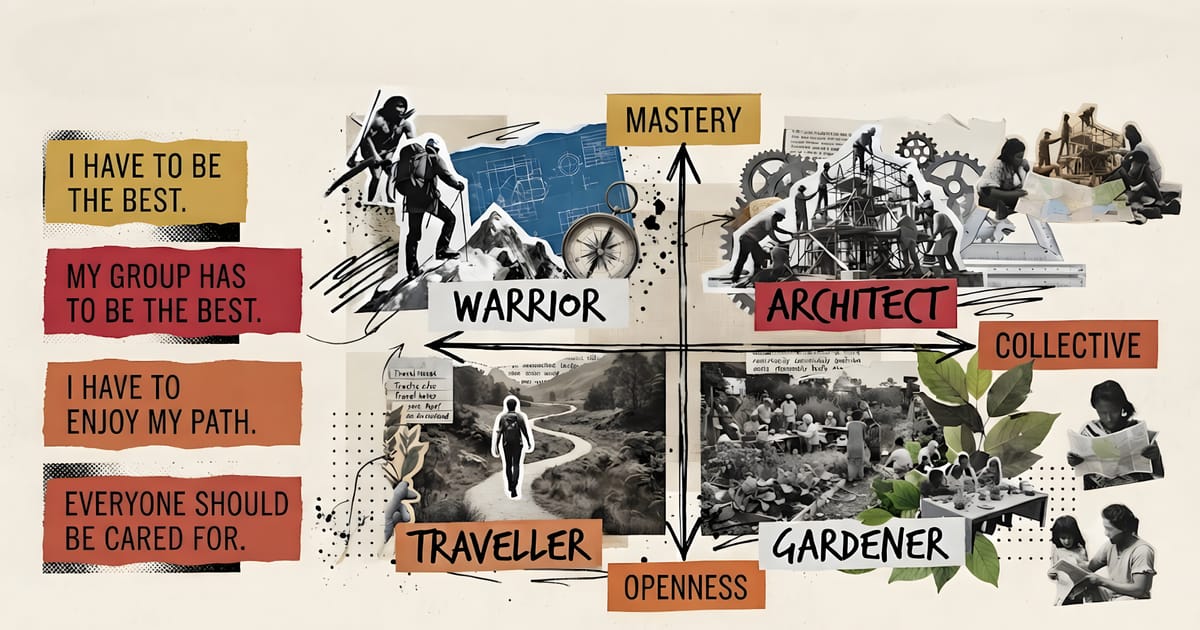
Most of what moves you is hidden from you.
You can describe your job, your family, your ambitions. But ask why the same argument keeps happening in your head, or why certain good decisions always feel quietly wrong, and words start to fail. That is not a vocabulary problem. It is because the forces doing the choosing - your values - sit below the surface, shaping how you feel, what you choose, and what you conflict about, without ever being named out loud.
Why Values exists to show you what is hidden in you.
Why we don't ask you to pick words
Most values assessments hand you a list of value words and ask which ones sound like you. We think that approach has a flaw at its foundation: it assumes you already know what the words mean to you, and that your self-perception is accurate. But courage looks different to different people. So does humility. The distance between the person you describe and the person you show in action is exactly where the interesting truth lives.
So we built something different. Why Values is the first assessment that uses active imagination - immersive situations drawn from the Jungian tradition - to watch what you actually choose when you are not choosing what to believe about yourself. The result is rarely the list of admirable words people expect. It is usually more surprising, and far more useful.
Archetypes, not labels
You are not a set of keywords to aspire toward. You are a living combination of value patterns - what we call archetypes: the Warrior, the Gardener, the Architect, the Traveller, the Mediator, the Visionary, the Storyteller, the Learner, the Charmer, the Executor.
When you say "I care about people," that can mean a dozen different things. When you discover you are a Gardener, something clicks. An archetype carries your identity, your blind spots, and your signature conflicts in one recognisable shape.
What we believe about values
Everything we write and build rests on a few convictions:
- Values are abstract - and value words alone flatten them.
- People cannot be boxed into words. Values form collections, and collections form archetypes.
- Values are a range, expressed across many behaviours, never a single fixed trait.
- Values are contextual - the same value looks different in different rooms.
- Values compete. They battle for priority inside you, and that competition is where your inner conflict comes from.
- All feelings are value-generated. Joy, frustration, peace - every core emotion is reality meeting, or failing to meet, a value.
- Almost all conflict - inner and outer - is value-generated. Which means almost all of it can be understood, and worked with.
Who this is for
If you work in psychology, organisation development, or coaching, Why Values gives you a rigorous, validated framework that goes where word-based tools cannot - including the blind spots of over-clinging to the values you are proudest of.
If you are simply a person trying to understand yourself, it gives you something simpler and rarer: a true picture, not a feel-good one. You are not defined by five value words. You are a warrior placed in a gardener's situation, or a gardener doing a warrior's job - and knowing which one you are changes everything about how you work, love, and choose.
Where to start
Take the Why Values Assessment and meet your archetypes. Join the free workshop to see the framework live. Or become a member and read along - we publish new pieces every week on the hidden forces that shape how people choose.
The point was never to collect value words. It is to finally see the machinery underneath them.
What's hidden in you is not a mystery. It is a framework - and it is waiting to be discovered.