A Low Mediator Score Is Not a Personality
Every assessment eventually meets the result it was not designed to handle, and the honest ones say so out loud. A flat values profile is not a personality - it measures the absence of access to values: exhaustion, low mood, or a self long performed rather than inhabited.
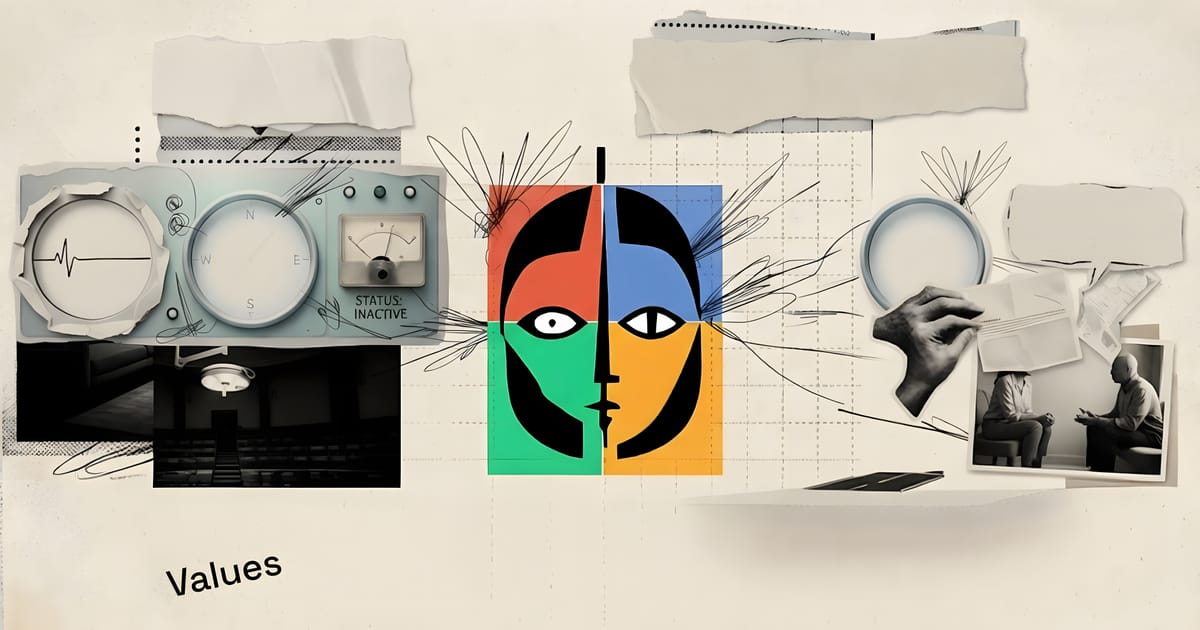
Every assessment eventually meets the result it was not designed to handle, and the honest ones say so out loud. The WHY Values framework's most clinically careful line concerns the profile where a person shows no strong value orientation in any direction - the low Mediator reading. The framework's own notes treat the pattern with a caution every assessor should memorise: people rarely live without any visible values, so this pattern may point to something deeper that calls for clinical support rather than coaching.
This article is about what a test must never do with a number - and it begins with what that caution gets exactly right.
A flat values profile is not who a person is - and it is never a verdict on them. Personality - in the clinical sense and the everyday one - is a pattern of typical behaviour, and people with a flat values reading are not typically nothing. They are typically exhausted, or low in mood, or recently devastated by events, or performing a self they do not inhabit, or living inside someone else's expectations for so long that the original signal has gone quiet. The values instrument, pointed at a person in any of those states, does not measure their values. It measures the absence of access to their values - which is a completely different clinical fact wearing the same number. Handing that number to a coach who is not trained to spot the difference is how assessment produces harm: the flat profile gets "developed," the exhaustion gets "engaged," and the person who most needed a referral to professional support gets a development plan.
This is the line between the two professions, and it is brighter than the industry admits. Coaching assumes a functioning navigator and asks, "where do you want to go?" Clinical work begins from the possibility that the navigator may need care before that question can even be asked, let alone answered. When an assessment result lands in the wrong room, the wrong question gets asked of a person who cannot currently use it - and the instrument takes the blame for the mismatch.
Every field with numbers has met this problem. Medicine learned it the hard way: a test is only as ethical as the interpretation wrapped around it. The psychometrics literature has known since Bertram Forer's 1948 demonstration - students rating a generic profile 4.26 out of 5 for accuracy - that people will supply the meaning themselves if the report does not supply the caution. Forer's students were given a fortune and believed it because they wanted to. The low-Mediator reading is the opposite failure, but the same principle: the number does not interpret itself, and the person reading it wants an answer too.
What must a test never do with a number? Three things: never let it outrun the instrument's design, never let it answer a question the instrument wasn't built to ask, and never let it stand where a human judgment should. A values map is a marvellous tool for the navigable life. It is not a diagnosis, and the flat reading is the field's permanent reminder of the difference.
The test of whether an instrument handles this edge case well is simple: read what the report says about your lowest score. Ethical instruments give it a paragraph and a referral. Commercials give it a label and an upsell. The difference is not cosmetic - it is the entire difference between a map that knows it is a map and a product that has forgotten. Before you trust any values framework with your team, ask the vendor one question: what happens when someone's profile comes back flat? The answer, or its absence, will tell you more about the instrument than any validation study.
Takeaway: A flat values profile is not a personality - it can be a signal that something deeper deserves care. If this reading feels like you, reaching out to a therapist or counsellor is a strong and worthwhile step; knowing what a test must never do with a number is what keeps an assessment ethical.