You Can't Assess Values on a Good Day
The candidate was excellent in the interview - and meant every word. Six months later he was hoarding information and managing upward. Nobody missed a signal; the signal did not exist yet.
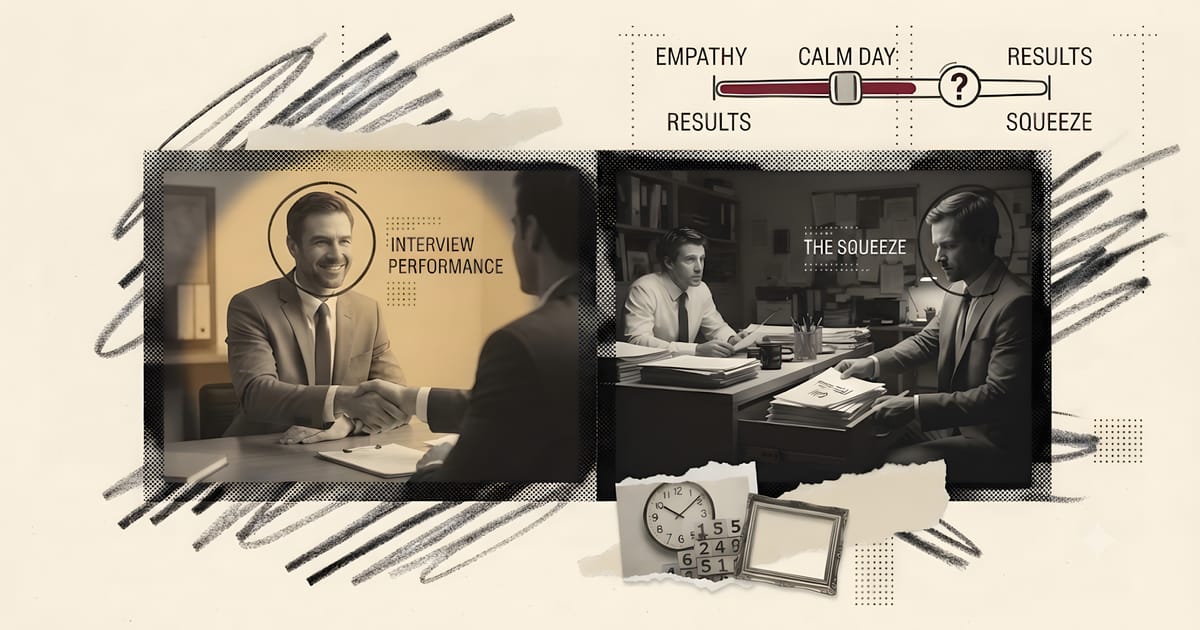
The candidate was excellent in the interview. Everyone said so afterward - composed, articulate, generous about his previous employer, thoughtful about failure. He said all the right things about collaboration, and here is the thing: he meant them. There is no reason to doubt a single word. Six months later, the same man was hoarding information from a peer team and managing upward with a skill the whole floor admired for the wrong reasons. Nobody in the interview process had missed a signal. The signal did not exist yet. He had been asked about his values on a good day, and good days are the one condition under which values tell you nothing.
This is not a complaint about interviews specifically. It is a structural fact about what values are, and the Why Values framework says so plainly: a person's values are a hierarchy, and a hierarchy only orders itself when two goods collide. When speed and care do not compete for the same hour, a person holds both at full strength and is, in every measurable way, someone who values both. The hierarchy shows itself only in the squeeze - the quarter when speed has to win or lose against care, in a specific decision, with costs attached. Calm-day answers measure vocabulary. Only conflict measures orientation.
The research on this is more uncomfortable than the interview industry admits. C. Daniel Batson's studies on moral hypocrisy gave people a fair-looking task with a private cheat available: they could assign themselves the good outcome while appearing fair. The participants - ordinary people - overwhelmingly endorsed fairness as a value right up until the moment they could quietly not practise it, and most cheated. Stated values predicted almost nothing about behaviour once a private advantage was in play. The gap between the two is not a personality flaw in those volunteers. It is the distance between a good day and a real one.
This does not mean values assessment is useless. It means the conditions under which you assess decide what you are measuring, and most assessment is run in conditions designed to produce flattery. Surveys are good days by construction. Interviews are performances under politeness. Even the observed group exercise is a room where everyone knows the values being watched for. Under all of it, the hierarchy stays folded - everyone holds every value, because nothing is making them choose.
So the practical corollary, which is the whole point of this piece: hire, promote and assess inside conflict situations, because that is where the hierarchy unfolds. Put the candidate in a decision with two defensible goods and one hour. Watch the promotion candidates in the quarter where two teams need the same person. Ask the question that forces a trade in the interview - not the illegal or theatrical ones, but honest ones: "Tell me about a time the empathetic choice cost your numbers. What did you do, and what did it cost?" The answer that admits a real cost describes a hierarchy. The answer where everything worked out describes a good day.
Leaders who have internalised this run calmer interviews and sharper organisations. They stop being disappointed that people's values "changed" under pressure. The values did not change. They became visible. The calm day was the illusion; the squeeze was the measurement. Anyone who has ever reorganised a team and watched who the dependable people turn out to be already knows this. The mistake is calling what happens next a surprise.
Takeaway: Values are hierarchies that only order themselves under conflict - calm-day answers measure vocabulary, not orientation. Hire and promote inside the squeeze, because that is the only lab where the hierarchy shows.