Growth Goes Sideways First
The star performer gets promoted, and the promotion is assumed to be the growth. But vertical moves test and reward exactly the strengths a person already has.
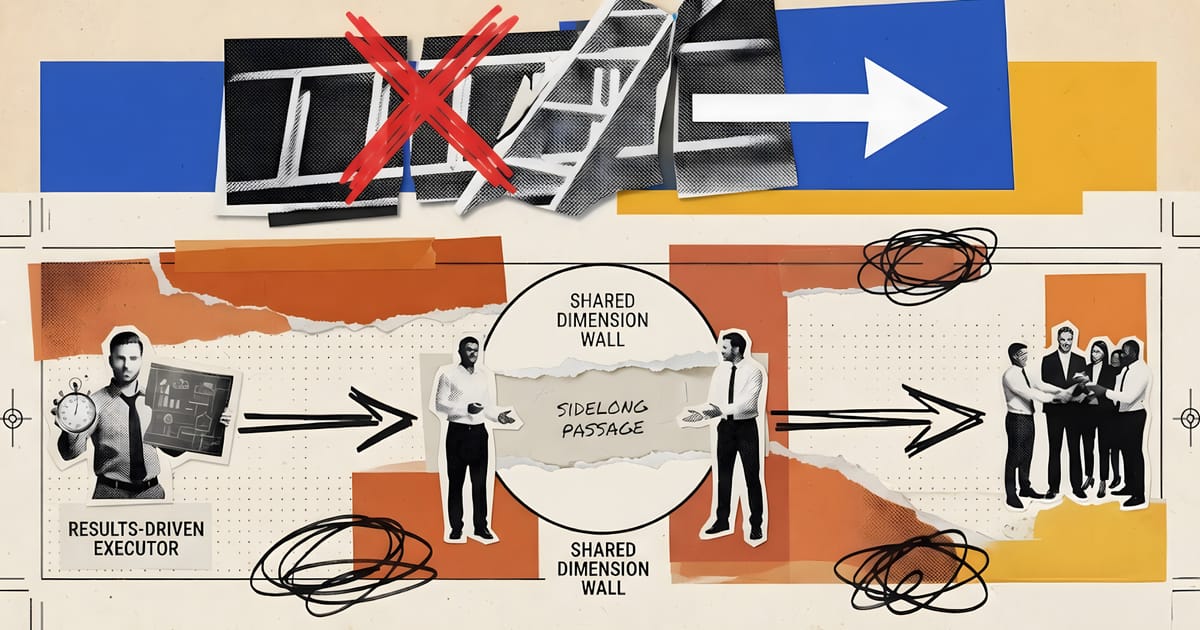
Here is how almost every company does development: the star performer gets promoted, and the promotion is assumed to be the growth. The org chart moves up a box; a bigger title, a bigger team, a bigger number. Then everyone wonders, about eighteen months later, why the person who was so alive in the role has gone quiet, or left, or turned into a tired middle manager nobody accuses of growing.
The mechanism underneath is simple and mostly unexamined: vertical moves test and reward exactly the strengths a person already has. The best salesperson gets a bigger territory; the sharpest engineer gets a bigger system to build. Promotion, as practised, is a machine for giving more scope to existing strengths. It is not a machine for developing new ones. And the person being promoted was not hungry for scope. They were hungry for the thing the org chart cannot give them, which is a new struggle - the particular joy of being a beginner at something, with the failure rate that entails.
Herminia Ibarra's research on working identity, built on studies of professionals in career transition, found something the promotion machine keeps failing to learn: people grow into new identities not by planning them but by doing - small experiments, side projects, provisional attempts at the self they might become. Growth happens sideways: in the sideways project, the sideways role, the sideways stretch that looks, on the org chart, like a demotion or a distraction. Her subjects did not think their way into new selves. They acted their way there, in experiments too small for the org chart to notice.
The other half of the finding is more radical, and most companies would rather not hear it: real development looks like incompetence. Publicly, at first. The senior leader who signs up to learn design thinking, the CFO who joins the product team, the ops manager who takes a rotation in sales - each one is visibly worse at something than their rank implies. Organisations say they want growth and punish the appearance of not-knowing. You cannot have the first without funding the second.
Watch what an actual development conversation does, and the difference is visible in one meeting. The vertical conversation asks: where do you want to be in three years, and what is the path? The sideways conversation asks: what would you like to be bad at? The first question produces a promotion plan. The second one produces energy, usually immediately, because the person has been asked about appetite instead of ambition - and appetite is the thing that was actually hungry.
So if you are a leader designing development for someone real, do the uncomfortable arithmetic. Take the thing they are excellent at, and note that the org chart will keep feeding it. Then find the adjacent incompetence they keep circling: the engineer drawn to customers, the manager drawn to craft, the analyst drawn to the stage. Fund a sideways experiment in it - small, provisional, reversibly embarrassing. The vertical track rewards the strengths. The sideways track is the only one that grows anything new.
Takeaway: Vertical moves reward existing strengths; growth happens in sideways experiments that look like detours. Ask what someone would like to be bad at - that is where the new self is acting its way in.