You Cannot Hold Both Ends (The Polarity Problem)
Can't one be compassionately task-oriented? Yes - in the week. Never in the moment. Values are not a buffet but a budget, and the orientation is the spending order: the tiebreaker you use, unnoticed, when the kind thing and the achievement-maximising thing finally diverge.
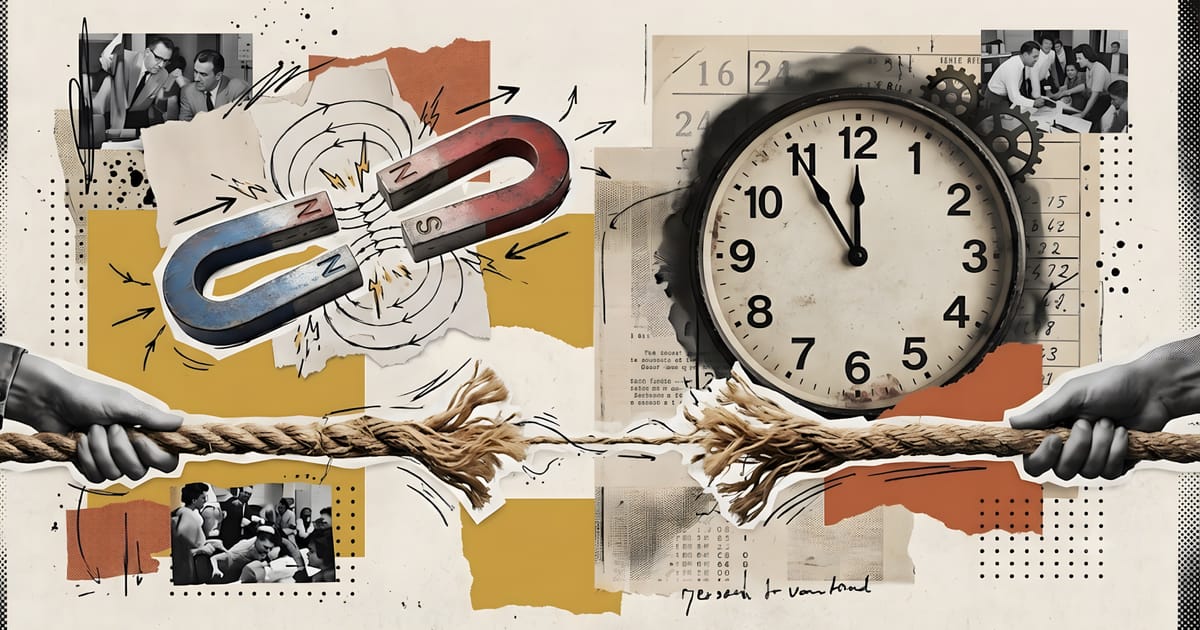
Can't one be compassionately task-oriented?
The question arrives in every workshop, usually about fifteen minutes after the value circle goes up on the wall, and it deserves better than the pat answer it usually gets. Because the questioner has noticed something real. Managers are kind and drive their teams. Parents are strict and beloved. Missionaries build hospitals. The circles say these values conflict; the lived evidence says they coexist in the same person, sometimes before lunch.
The circles are right anyway. Schwartz's model - and the WHY Values framework inherits this from it - does not say you cannot do benevolent and achievement-oriented things in the same week. It says something more precise: you cannot optimise both simultaneously, because optimisation is precisely the act of ranking. When the kind thing and the achievement-maximising thing diverge - and over a career, a marriage, a company, they always eventually diverge - one ends up breaking the tie. Which one breaks ties is the value orientation. The rest was scheduling.
The philosopher Isaiah Berlin spent a career documenting this from the political side: good ends - liberty and equality, mercy and justice - collide not because one side is wicked but because values genuinely conflict at the margin where they compete for the same hour, the same rupee, the same child. Schwartz gave the collision its empirical map; Berlin supplied the reason the map feels tight. The compression is real. So is the competition.
Watch the mechanism at 11 p.m. in an ordinary life. The phone buzzes: a friend in crisis - or the deck for tomorrow's nine a.m. Either choice is defensible; every value circle in the room would endorse both. But you can only answer one call. Whatever you pick, you have just optimised - and the tiebreaker you used without noticing was your value orientation. There is no third option called "balance" that answers both calls. The choice is the hierarchy. Everything else was scheduling.
So when the framework shows two circles of values and says the sides oppose, it is not legislating a monastic life. It is reporting an experimental finding: achievement obstructs benevolence - not always, but at the margin, in the moment of choice, over time. Values are not a buffet. They are a budget, and the orientation is the spending order.
Which is why the most important setting in a person is not the values they endorse but the order they default to when the values collide - and why the most valuable thing a framework can do is make that default visible before the 11 p.m. calls do it for you. The hierarchy is not the bug in values. It is the engine.
There is a quieter consequence that reaches past self-knowledge into every relationship you will ever be part of. Two people can endorse the identical value set and still collide - because endorsement is the menu, orientation is the order. The parent and the adult child both "value family," then fight for a decade about holidays, money and unsolicited advice: each is running family against something else in the tiebreaks, and neither has ever seen the other's sequence. Most long conflicts are two reasonable hierarchies wearing each other down. The fight is never about the menu. It is about the order.
Takeaway: You can hold every value; you cannot hold both ends. Optimisation means ranking, ranking means a tiebreaker, and the tiebreaker - not the vocabulary - is the person.