The Middle of the Map Is the Hardest Place to Reach
The middle of the value map is not a blend of the poles but the far side of mastering both - full individuality with full collectivity, full mastery with full openness. Every tradition points there and charges the same price: finish your pole first. What the middle costs, and who gets to rent it.
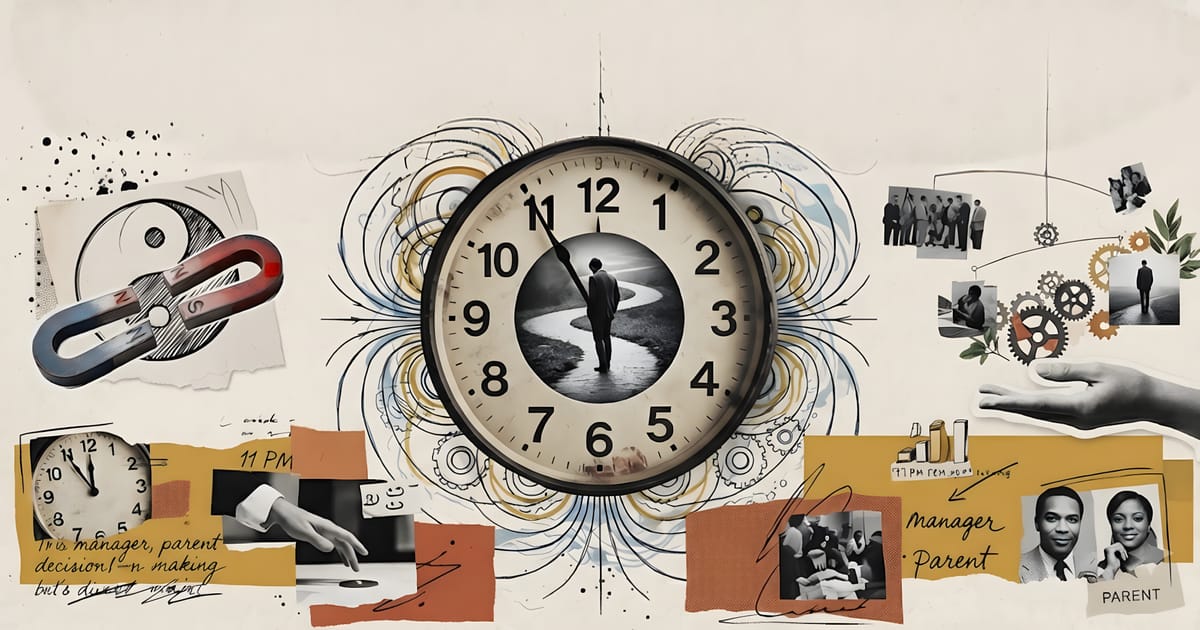
Every value map has a middle, and the middle is where almost nobody lives. Not because they cannot find it - because of what it costs to stay.
Consider what the middle of the WHY Values map actually asks. The person halfway between individual and collective must be fully individual - whole, self-standing, their compass their own - and fully collective at the same time, holding the group's good as their own without dissolving into it. Not a compromise between the two. Both, entire, without contradiction. Or look at the other axis: the middle of mastery and openness is a person who can act upon the world at full force and receive what comes at full force - the archer's complete effort and the stoic's complete acceptance in the same heartbeat.
Most spiritual traditions point at exactly this address and then warn you about the rent. Vedanta calls it moksha. Taoism's watercourse way is this middle: effortless action, wu wei, the master who does nothing yet nothing is left undone. Jung spent a career describing individuation as the holding of opposites - not their averaging, their holding. Every tradition that maps the territory makes the same observation: the state is real, it is the summit of the possible, and almost no one gets there by wanting it.
The frameworks agree on why, too. The middle cannot be occupied by a person who still needs the poles for identity. The one who defines himself as a rebel needs the system he opposes; the one who defines herself as a servant needs someone to serve. Each pole, held as identity, keeps the other pole alive as shadow. The middle has no shadow to lean on - it must generate its own centre of gravity, which is why every tradition describes it as less a location than an achievement.
Now scale the picture up, because the same physics governs organisations, cultures and civilisations. A company can be briefly individual (the founder's 6 a.m. conviction) or briefly collective (the early team's shared necessity). The "learning organisation" everyone wants to be is simply a group-sized version of the middle: full local autonomy held together by full shared purpose, no half-steps. It is rare for the same reason the personal middle is rare - groups vote it into a policy before lunch. What they get instead is a thousand accurate half-steps: improvement programmes, engagement surveys, culture decks that describe the middle without paying for it.
None of this makes the middle unreachable, and it is worth being precise about the route, because the route is the one all the traditions name: through the poles, not around them. The individual must first become fully individual - own their heading, their hunger, their wake. The collective must first be genuinely served - not performed, served. The master must master something completely; the open one must receive something completely. The middle is not between the poles. It is past them, on the far side of competence at both. Integration is not a compromise. It is a completion.
Which is also why the middle cannot be assigned, facilitated or workflowed into existence - and why the frameworks that promise it as a feature should be read as poetry. What can be done is smaller and realer: know your pole. Own it without apologising. Pay its full price. The middle is rented only to those who have stopped needing it as an escape from a pole they never finished.
The test for whether you or your organisation has visited the middle is simple and brutal: it is the only address from which you can see the whole map - and describe the poles without flinching, ranking, or needing either. Everyone else is describing their address.
Takeaway: The middle of the map is not a blend of the poles but the far side of mastering both. Every tradition points there and charges the same price: finish your pole first.