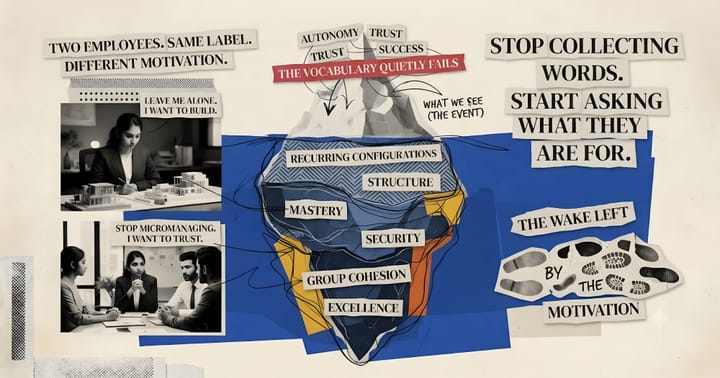
We Fired the Word "Enhancement"
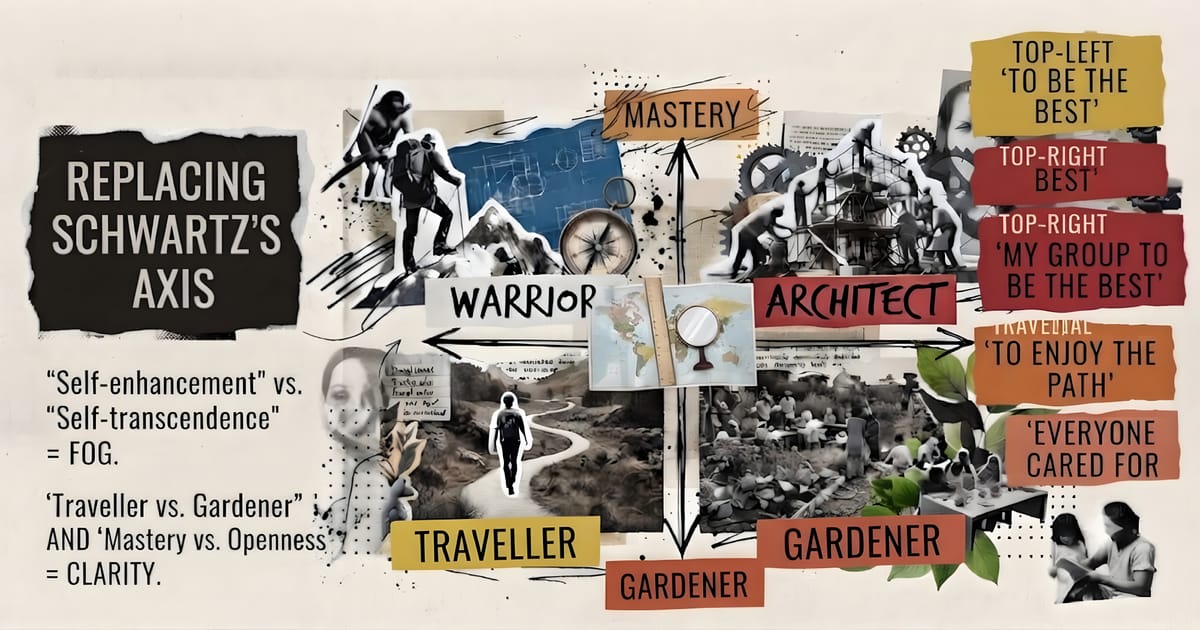
Taxonomy is not neutral. Schwartz's "self-enhancement" files the marathon runner with the wandering poet - and hides the distinction that explains them. The framework replaced the axis with two clean questions: individual vs collective, mastery vs openness. Direction, not virtue.
This is a story about firing a word, and why the framework could not build what it needed to build until it did.
The word was "self-enhancement." It arrived by way of Shalom Schwartz, whose circular model of universal values is the most respected mapping in the field - tested in more than 80 countries, and the reason any serious values framework owes him a debt. Schwartz organised human values into a circle where neighbouring values coexist comfortably and opposite values conflict: pursuing achievement, the model says, functionally obstructs benevolence. You cannot maximise both at once. The circle earned its shape from data.
But Schwartz named two poles of the circle "self-enhancement" and "self-transcendence," and something in those names never sat right. The problem is not pedantry. It is that both names smuggle in a goal - and the goal is the wrong variable.
Consider what actually happens in people. Someone driven to master their environment - to build, to win, to bend the world - and someone driven to enjoy their path - to savour, to experience, to be present - are doing profoundly different things with their lives. Under Schwartz's naming, both get filed as "self-enhancement," because both are, in some loose sense, oriented toward the self. But file them together and you have erased the very distinction that explains them. A marathon runner and a wandering poet are not the same orientation with different hobbies. Nor, on the other side of the circle: the collective-minded person who wants their group to win and the one who wants everyone cared for are both "self-transcendent," and yet no two orientations are more different in a crisis.
The deeper problem was that "enhancement" and "transcendence" describe destinations - goals both poles can pursue. The master and the hedonist can both be said to be "enhancing the self"; the patriot and the saint can both be said to be "transcending" it. When a dimension's name describes something true of both poles, it stops revealing what it should reveal. It becomes a fog.
So the framework replaced the axis. Individual versus collective: does the self-concept stop at one person, or does it extend to the group? Mastery versus openness: is the drive to act upon the environment, or to be receptive to it? Two clean questions, four legible quadrants - and no word that quietly grades the people being measured.
The larger lesson is one most frameworks never say out loud: taxonomy is not neutral. The words you file people under determine what you can see about them. Globalisation had already made the old names wobble - "self-enhancement" reads differently in Stockholm and Surat. The repair was to choose names that describe the location on the map, not the judgement of it. Direction, not virtue. Geography, not grade.
The rename has one more consequence worth spelling out, because it changes who can use the framework. Under the old names, whole quadrants arrived pre-judged: "self-enhancement" sounded like a diagnosis, and cultures that prize modesty scored themselves defensively against it. Under the new names, the map describes before it evaluates - which is what makes a cross-cultural instrument honest. A metric that flatters Stockholm and indicts Surat is not measuring values. It is measuring distance from Stockholm. The repair was not cosmetic. It was the difference between a mirror and a ruler.
The practical test of any rename is simple: can a practitioner use the new terms in a heated room without triggering a side argument? With "enhancement," the side argument arrived every time. With "individual versus collective," it almost never does - and that silence is the sound of a taxonomy finally describing the world instead of arguing with it.
Takeaway: When a label fits both poles of a dimension, it hides the distinction it was meant to reveal. "Individual vs collective" and "mastery vs openness" say plainly what "enhancement" muddied.