Virat Kohli and Rohit Sharma Leave Tests but Resist a Ready-Made Ending
Two modern greats stepped away from Test cricket while refusing the ready-made ending of a full ODI retirement. The farewell courtroom is less interesting than the negotiation underneath.
Indian cricket finds it difficult to let its great players make a decision without turning it into a verdict on their entire lives. A retirement becomes either the perfect farewell or an eviction. Continuing becomes either devotion or vanity. Between those poles sits the rather less theatrical work of deciding what a person can still give, and what a team now needs.
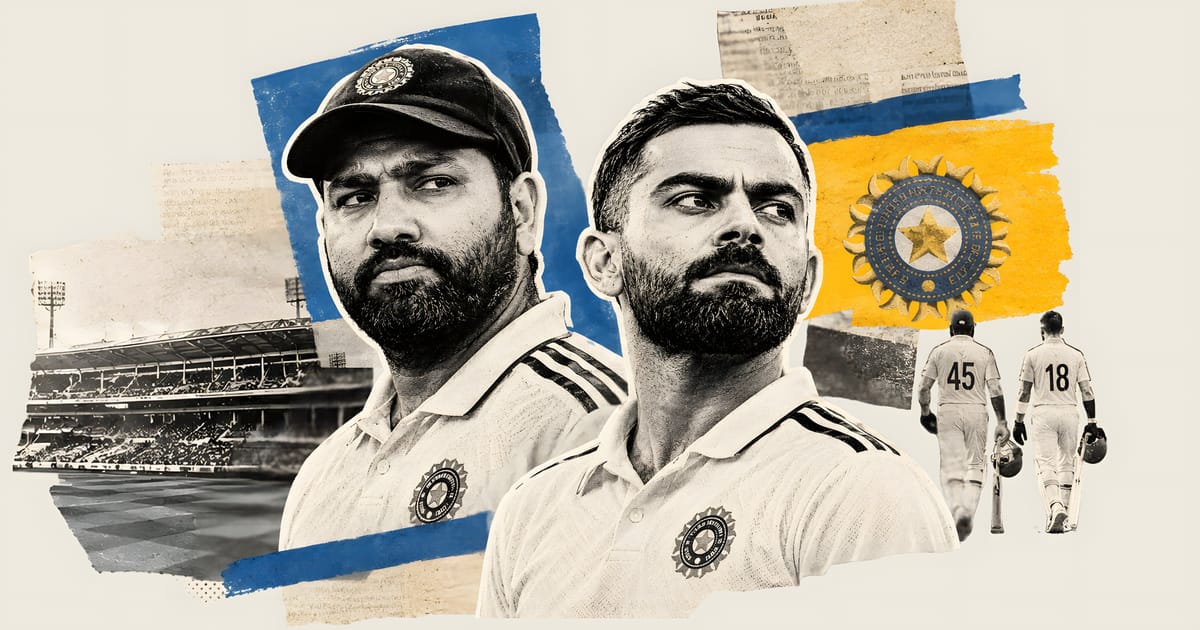
Rohit Sharma announced his Test retirement on May 7, 2025. Virat Kohli followed on May 12. Both retained their availability for one-day internationals. AFP's report on Rohit's announcement set the decision against poor recent form and questions about the captaincy. Reuters' account of Kohli's departure preserved a more intimate explanation: the format had tested and shaped him, and he was leaving with gratitude.
Those accounts describe circumstances and public statements. They do not establish that either player was secretly forced out. Later that month, chief selector Ajit Agarkar called the retirements "personal calls" and said Kohli had approached him in early April. In AFP's coverage of the selection announcement, loss and opportunity appeared together: enormous gaps to fill, room for successors to grow.
That pairing is where the Why Values framework offers a more productive reading than the usual farewell courtroom.
Its self-concept dimension distinguishes the individual from the collective. Kohli and Rohit have careers that belong to them: bodies, aspirations, memories, limits. They also occupy roles inside a team whose future belongs to more people than its most famous members. The conflict does not require selfish veterans or ungrateful selectors. It exists because legitimate claims can pull in different directions.
On the drive dimension, mastery encourages training, correction and another attempt. Receptivity allows changing conditions to matter. Ending one format while continuing in another may be a practical way of negotiating those demands. It does not prove that someone has reached the framework's integration zone; the documents distinguish enduring integration from situational choices. But it does expose the poverty of treating all withdrawal as defeat and all persistence as courage.
The dispute returned in July 2026, this time around Rohit's ODI future. Reports suggested selectors had moved beyond him in their World Cup planning. BCCI secretary Devajit Saikia publicly rejected the claim that the coming Lord's match would be his last. Outlook's account of his PTI interview includes both the speculation and the denial. They should remain separate; a denial is not a proof that no disagreement existed, and speculation is not a proof of a forced retirement.
Rohit then scored 138 at Lord's. India still lost. Captain Shubman Gill said Rohit had communicated no retirement decision to the team, according to the subsequent match reporting. The innings complicated the conversation without resolving it. A century is evidence of ability. It is not, by itself, a complete selection policy.
Here we can see the Warrior and Architect archetypes in action: the insistence on proving oneself, and the obligation to sustain the team beyond any individual. Their coexistence is essential. The first becomes destructive when every selection discussion feels like a judgment of personal worth. The second becomes destructive when succession is treated as an administrative exercise with no human cost.
The framework's Athlete blind spot, dependency on external validation, also belongs in the discussion, though not as an allegation about either player. The surrounding culture can cultivate it. If supporters teach a champion that continued selection certifies greatness, leaving becomes unnecessarily humiliating. If officials explain succession only through vague messages and anonymous briefings, they make ordinary uncertainty feel like betrayal.
A better settlement would separate dignity from entitlement. A player deserves candour, respect and ownership of his retirement announcement. He does not own a place indefinitely. A selector owes the team a future, but cannot use that duty to excuse careless treatment of its past.
Kohli and Rohit have already demonstrated that a career need not end all at once. The difficult question is whether the rest of Indian cricket can accept a departure in stages without insisting that every stage supply a villain.