D Gukesh Loses in Goa and Faces the Work of Being Champion
A world title does not protect a chess player from the next position. Gukesh's 2025 World Cup exit is part of the champion's workload, not a contradiction of it.
A world title does not protect a chess player from the next position. This sounds too obvious to require saying, until a champion loses and the result is treated as if it has exposed a fraud rather than decided a game.
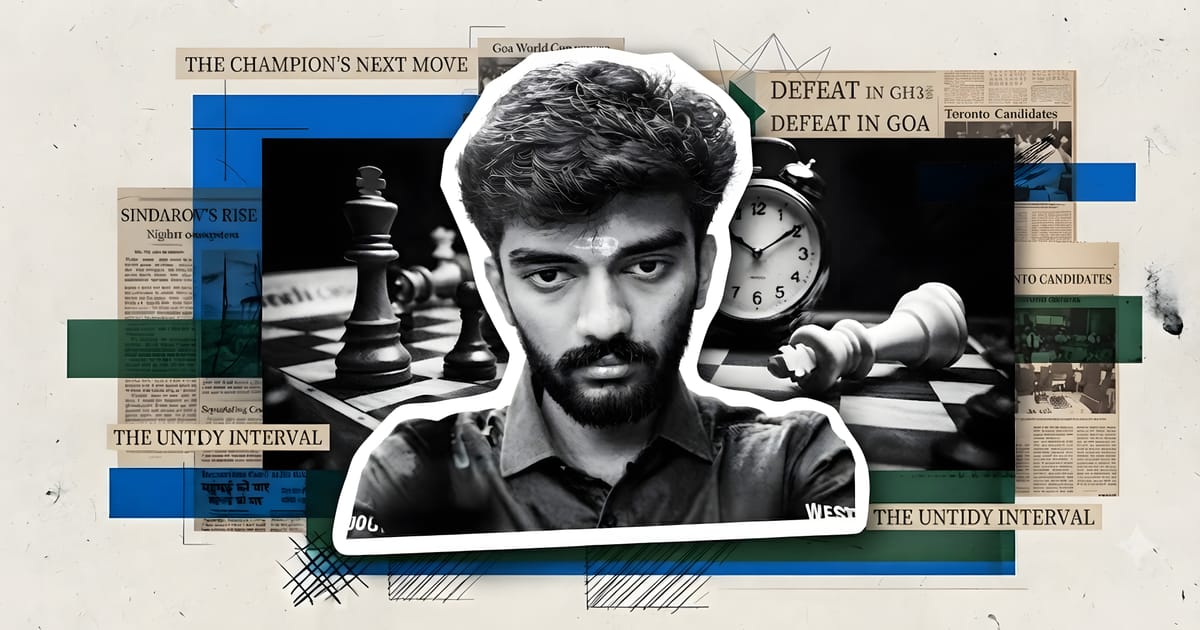
On November 8, 2025, D Gukesh was eliminated from the World Cup in Goa by Frederik Svane. The world champion, then ranked ninth, lost a two-game third-round match to the player ranked 85th. India Today's report describes a drawn first game, followed by Gukesh pressing for victory with White in the second. Svane survived time pressure and won the ending. The match score was 1.5-0.5.
The year matters. This was the 2025 World Cup, not a 2026 event unfolding now. Its relevance lies in what followed: the long, untidy interval between becoming the youngest world champion and having to defend the achievement against an opponent building a formidable case of his own.
In April 2026, Javokhir Sindarov won the Candidates tournament to earn that challenge. Reuters' report, carried by Al Jazeera, recorded him securing first place with a round to spare. His confidence was accompanied by an acknowledgment of Gukesh's experience and the work his own team still needed to do. The championship match had not taken place at the time of writing.
There are several perfectly adequate chess explanations for a champion's uneven tournament results. Match preparation and open events demand different things. Short knockouts punish a bad day. Strong players outside the highest ranks remain capable of exceptional games. None of those explanations requires a crisis of identity. We should resist making every lost position carry a psychological diagnosis it cannot support.
The Why Values framework offers a perspective on the pressures surrounding the results, rather than a substitute for analysing the moves. Its self-concept dimension asks whether meaning is located primarily in individual achievement or membership of a collective. A champion has earned a singular title. Yet the preparation, support and expectations around it are shared. The public sees one person at the board and can forget how much collective labour makes that solitude possible.
The drive dimension introduces another tension. Winning rewards the capacity to act decisively, prepare deeply and trust a judgment. Improving after defeat requires receiving unwelcome information. A title certifies something already achieved. It cannot make the next error less instructive.
In this reading, the Warrior and Gardener archetypes are in action together: the desire to become better and the conditions that allow development, including room for failure. Their diagonal combination is the Learner. The framework describes its action as knowing, with questions and a growth mindset among its resources. The tension here is not a flaw to assign to a young player. It is a question about the environment in which he works: can a culture demand championship performance while permitting the learning that performance requires?
ESPN's April 2026 preview of Gukesh against Sindarov quoted Gukesh acknowledging disappointing recent results, including disappointment for his supporters. That is a statement of awareness, not evidence that he has become dependent on their approval. Still, it reminds us that a champion's work takes place inside a relationship with an audience that remembers the summit more readily than the climb.
Here, Solidarity and Equity illuminate the audience's responsibility. A competitive community needs standards, selection and distinctions; a world championship would mean little without them. Recognising equal human worth, however, means refusing to turn those distinctions into a verdict on who deserves patience or dignity. A lost match can justify criticism of decisions without making the player less worthy of regard.
That is not an argument for protecting Gukesh from scrutiny. It is an argument for making scrutiny useful. Ask what happened on the board, which decisions mattered and what might improve. Declaring a young champion finished tells us far more about our appetite for dramatic endings than about his next move.
Gukesh's title and his Goa defeat belong in the same account. Neither cancels the other. The difficult task of being champion is to carry the authority of the first without making it impossible to learn from the second. The difficult task for everyone watching is to let him.