Two Questions That Explain Almost Anyone
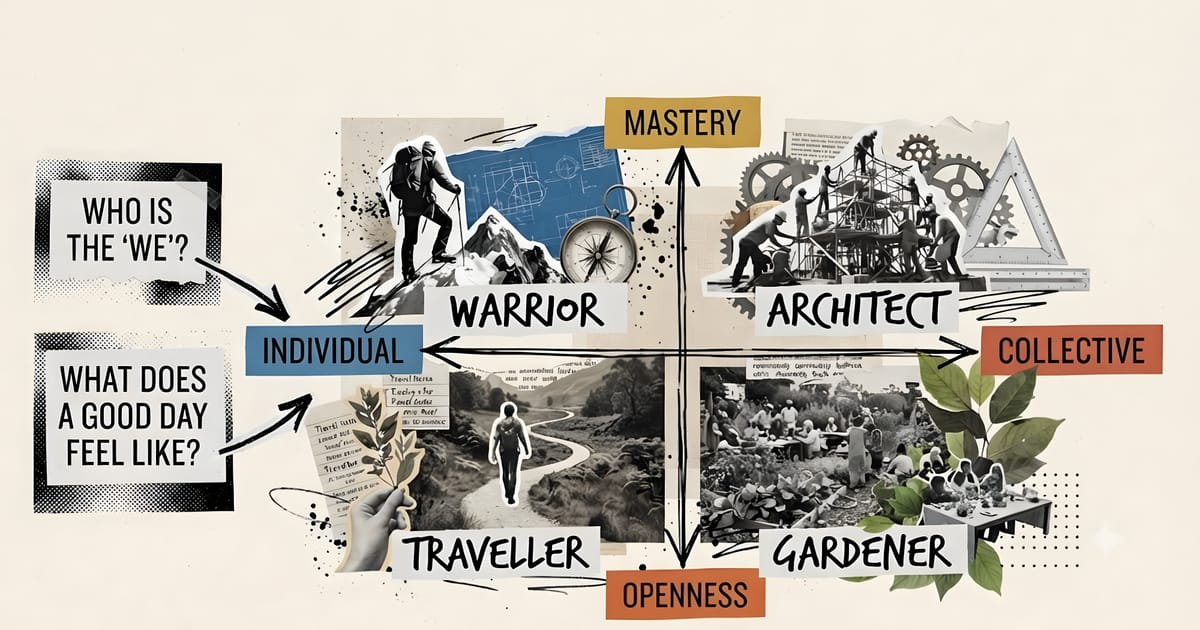
Strip away the assessments and two questions do most of the work: where does the "we" end, and what does a good day feel like? The WHY Values framework runs on two dimensions - self-concept and value drive - because they are generative, not inventory.
Strip away the assessments, the workshops, the forty-page reports, and two questions do most of the work:
Does this person define themselves as an individual or a collective? And are they driven to master their environment, or to be open to what happens?
That is the entire architecture of the WHY Values framework. Two dimensions. Four quadrants. And an unreasonable amount of exploratory power.
Consider how much of adult behaviour these two questions actually sort. The first - self-concept - decides where the "we" ends. One person plans a career as a solo instrument; another plans it as a chapter in a family story; neither can easily imagine the other's planning process. The second - value drive - decides what a good day feels like. The mastery-driven person feels alive when the environment bends: the deal closes, the system ships, the mountain summits. The openness-driven person feels alive when the environment is allowed to be: the conversation meanders somewhere true, the team finds its own rhythm, the morning unfolds. Tell one of them to "go with the flow" and you have issued an insult; tell the other to "take charge" and you have issued the same insult in different clothes.
The reason two dimensions go so far is the same reason a map with two axes goes further than a list of a thousand adjectives: they are generative. Most personality vocabularies are inventories - long lists of traits, each independently measured, each fuzzily related to the others. A dimensional map is different. It places you in a space, and your position explains many things at once: what stresses you, what you find boring, what you secretly disrespect, what kind of partner you look for, what kind of boss you become. Four quadrants, each with its own logic, its own heroes, its own characteristic failure.
The framework's four archetypes - the Warrior who must be the best, the Architect whose group must be the best, the Traveller who must enjoy the path, the Gardener who must care for everyone - are not types in the horoscope sense. They are the four corners of a map, and like any map, they earn their keep by making predictions. Predict which colleagues will clash in a reorganisation. Predict which founder will strangle their own company's growth. Predict which of your friends will hate the surprise party. Most people can be located on this map within two paragraphs of honest conversation - and, more strikingly, most people recognise themselves within two paragraphs of description, which is the reaction that never happens with trait lists.
Two questions, then. Who is the "we"? And what does a good day feel like? Answer them for anyone - yourself included - and you have done more exploratory work than most personality reports manage in forty pages.
A caution belongs here, because two-axis maps have a failure mode all their own: the rush to file. The moment the quadrants have names, people start sorting their colleagues over coffee, and the map degrades into a party trick - "oh, he's such a Warrior" - which is astrology with better production values. The map earns its keep only as a hypothesis generator. It tells you what to watch for, not what someone is; the confirmation is in their decisions under pressure, not in your coffee. Every serious use of the framework comes with this warning stapled to it. The moment the map stops being revised by evidence, it has stopped being a map.
Takeaway: Self-concept and value drive - two questions, four quadrants. Locate a person on that map and their conflicts, cravings and blind spots stop being mysteries.