The Mysterious Apprehension
A low hum of doubt beneath an otherwise functional life is usually misread as anxiety or burnout. This piece argues it's something simpler: the cost of making large decisions without knowing your values.
There is a feeling that shows up in coaching sessions all over the world, and it rarely has a name. It is not depression. It is not quite anxiety. It is a low hum of doubt that plays underneath an otherwise functional life: Am I doing the right thing? Is this the right career, the right city, the right marriage, the right move? The person experiencing it is often doing well by every external measure - promoted, solvent, admired - which makes the feeling more disturbing, not less. If everything is right, why does nothing feel right?
The usual suspects get blamed, in roughly this order: burnout, social media comparison, a bad quarter, the news, low blood sugar. Some of these contribute. But look at the structure of the feeling and a simpler cause appears. The hum is loudest in exactly one situation: when a person is making large, consequential decisions without knowing what they are optimising for.
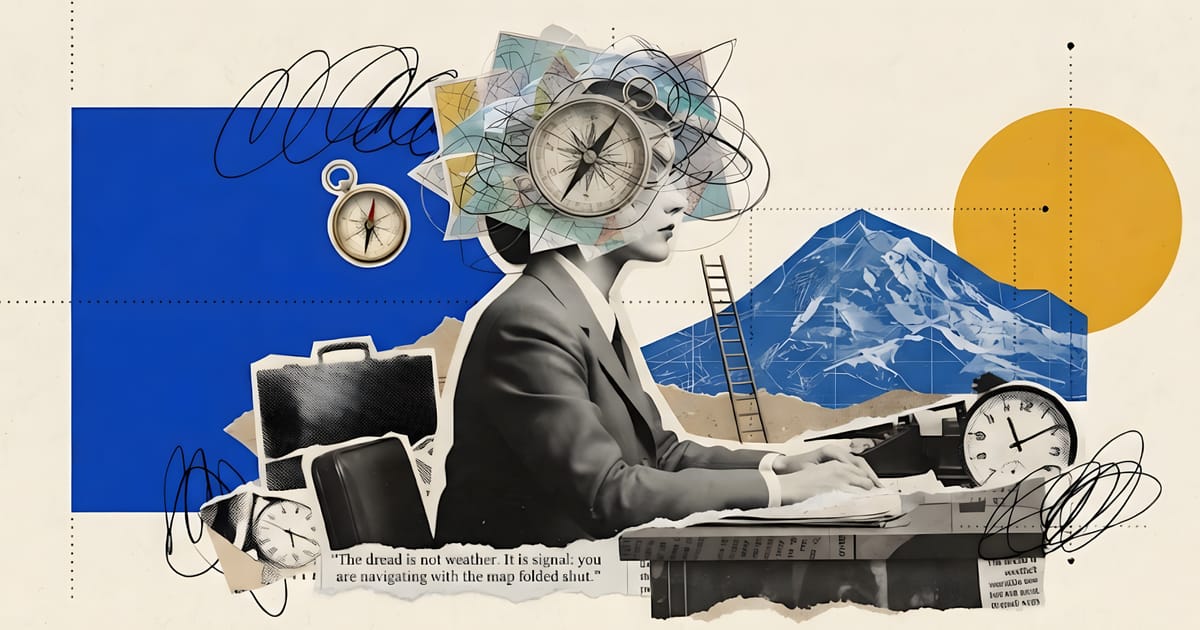
Suppose you are handed a compass but have no idea where you want to go. North is not better than south; you have no way to score either. Every direction therefore produces the same low-grade dread, because every direction is arbitrary. Now suppose you are trying to reach a specific mountain. The compass becomes decisive, trade-offs become answerable, and the dread becomes signal - useful information about terrain. Same device, different person.
The difference was never the compass. It was knowing what you were navigating toward.
Psychology has documented the cost of this gap from a different angle. Kahneman and Schkade's research on the "focusing illusion" found that people dramatically mispredict how much a change - moving to California, taking a higher-paying job - will affect their happiness, because while choosing they attend to one salient feature and ignore everything their values would actually weigh day to day. People mis-forecast their own futures not because the future is unknowable but because they don't know what to weight. Unmapped values guarantee the error, in both directions: away from the job that would have fitted, toward the city that looked shiny in the imagination and grey in February. The chronic dread of "what if this is wrong" is what that error feels like from the inside.
This reframing matters because of what it rules out. If the apprehension were a mental health problem, the remedy would be treatment. If it were a circumstances problem, the remedy would be a new job, a new city, a new partner - and many people cycle through all three and find the hum waiting patiently in the next life too, updated but unbowed. But if it is a mapping problem, the remedy is quieter and less expensive: find out what your values actually rank. Not what should matter, not what would look good on the announcement - what does matter, measurably, to you, when the options are real.
Most people never do this work. They treat the hum as weather and endure it for decades, telling themselves it is the price of ambition or the tax of sensitivity. It doesn't have to be weather. It can be a signal - the sound of a person navigating a rich, full life with the map folded shut.
There is also a version of this that strikes groups. Teams have it - the low hum in the quarterly review when everyone senses the strategy is wrong but nobody can say against what standard. Marriages have it, and so do friendships, and so, famously, do successful people at the height of a career they no longer remember choosing. The common thread is never a lack of options. It is the absence of a scoring function. Where the map is missing, every road is equally wrong, and the loudest voice in the room - anxiety - becomes the navigator by default.
Takeaway: That low, chronic "am I doing the right thing?" is rarely a disorder. It is the cost of making big decisions without knowing your values. You are not unwell. You are unmapped.