"Is This Me?" Is the Wrong Question
The defining question of a generation assumes a fixed "me" that doesn't exist. This article reframes identity crises as literacy problems - and offers the better question: which of your values is speaking right now?
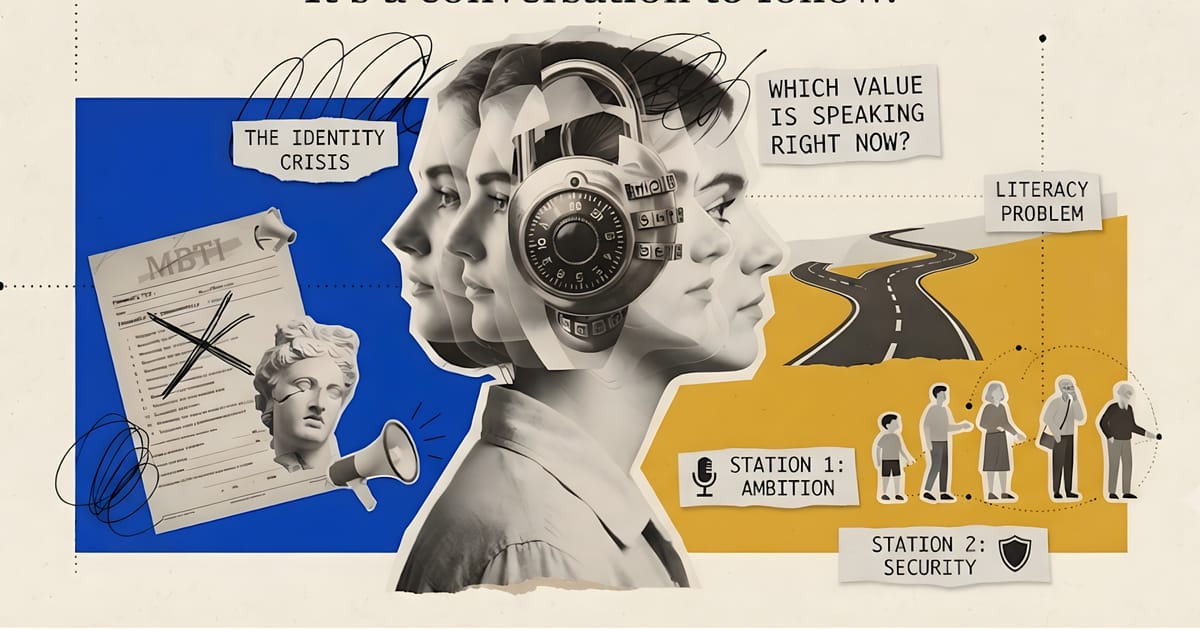
Somewhere right now, a bright twenty-something is in the middle of what they will later call their identity crisis. They took the assessment, got a type, joined the community, built a small aesthetic around it. And then, eighteen months later, they took the assessment again and got a different answer. Now they feel betrayed - by the test, by the coach, by themselves. The self they thought they had finally found has changed shape.
The first thing to know is that the instruments deserve some of the blame. David Pittenger's widely cited reviews of the Myers-Briggs Type Indicator found that a large share of people - in several studies, between a third and three-quarters - receive a different type when they retest weeks or months apart. A tool that assigns you a fixed four-letter identity and then hands out a different one on retest is not measuring a fixed thing. Bertram Forer showed in 1948 how willing we are to fill that gap: his students rated a generic personality profile, identical for everyone, at an average of 4.26 out of 5 for accuracy. We want the fixed self so badly that we will grade a fortune cookie as a diagnosis.
Here is a different hypothesis, and it is the one our framework is built on. The "self" people are hunting for is not a fixed object at all. Your values behave less like a statue and more like a combination lock - a small set of threads (individual versus collective, mastery versus openness to experience, and a few others) whose configuration changes with season, role, and pressure. At 25 the combination might read "prove myself, individually." At 45, "lift the people around me." At 60, something that finally looks like integration. All three were you. The failure was assuming one of them was the real one and the other two were errors.
Which means the defining question of the modern generation - "Is this me?" - is structurally unanswerable, because it assumes a fixed "me" to align with, and no such object exists to check against. A better question, and one that can actually be answered, is: "Which of my values is speaking right now?"
The difference sounds like wordplay. It is not. "Is this me?" produces binary judgements about whole identities - take the job, leave the city, end the relationship - and each wrong guess feels like self-betrayal, which is why identity crises are so exhausting. "Which value is speaking?" produces a reading. It lets you notice that the panic about the job offer is your security thread talking, not your ambition thread - and that you are allowed to listen to one without being sentenced by it. Identity stops being a verdict and becomes a broadcast: several stations, all yours, playing simultaneously. Maturity is not picking one station and calling it the truth. It is learning which one has the mic right now.
Identity crises are, in this light, mostly literacy problems. People haven't stopped knowing themselves. They never learned to read the moving parts - and no personality type can teach them, because the parts move.
You can watch the cost of the old question in how people talk at thirty and at fifty. The thirty-year-old asks "is this me?" and treats every misfit as evidence of a false start. The fifty-year-old who has done the literacy work asks a different question and describes her twenties differently: not as a series of wrong selves, but as a sequence of correct readings of a moving instrument.
She does not regret the person she was at 25. She can explain him.
That explanatory power - the ability to narrate your own past without cringing or rewriting it - is the practical payoff of treating values as a conversation rather than a statue.
Takeaway: Stop asking whether a choice matches the real you. Ask which of your values is talking. The self isn't a statue to match - it's a conversation to follow.