Mastery vs Hedonism: The Athlete and the Convalescent
The athlete's discipline is the joy; the convalescent's rest is the maintenance. Neither is suppressing anything - both are ranking.
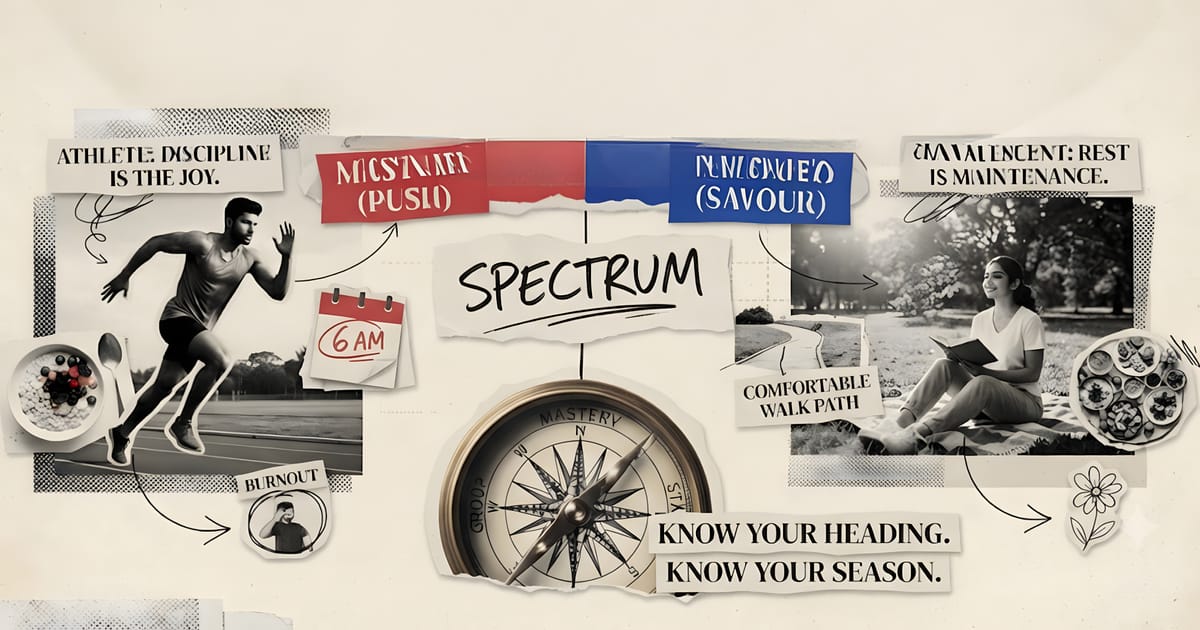
The spectrum running from mastery to hedonism is easier to see in two people than in a diagram. So imagine two.
The first wakes at six, tracks his macros, and trains like the season matters - because to him it always does. Discipline is not a tax he pays on his way to enjoyment; the athlete's discipline is the joy. The second is a convalescent of a different kind: reads in the afternoon sun, eats when hungry, walks the comfortable path - and would tell you, sincerely, that he has never been happier or more himself. The athlete would call that settling. The convalescent would call the athlete's life a postponement. Neither is describing the other accurately. Each is describing his own compass.
This is the spectrum the WHY Values framework measures as mastery versus openness. The pole of mastery is the drive to act upon the world: to build, strain, achieve, impose the will on matter and circumstance until they yield a result. The pole of openness is the drive to receive: to let experience arrive and be had, to adapt rather than bend, to savour what a moment offers instead of what it can be made to yield. Most lives are not lived at either pole. They are lived somewhere along the spectrum - and the location, not the intensity, is what the framework is trying to read.
Two clarifications keep this spectrum honest. First, "hedonism" is a slander from the mastery pole, the way "repressed" is a slur from the other direction. The openness-driven person is not lazy; rest, to them, is not the absence of achievement but a different activity with its own goods - attention, availability, being happily idle in a way that a culture of optimisation has priced at zero. And the athlete is not "disciplined" as a sacrifice. Ask him what he gets from the 6 a.m. run. The answer is not "virtue." It is joy - of a specific, effortful, mastery-flavoured kind that the convalescent's December sun cannot produce and was never supposed to.
The scientific ground for taking both poles seriously is solid. Csikszentmihalyi's flow research found that people report their deepest satisfaction not in passive pleasure but in effortful absorption - the state of a skill fully engaged against a real challenge. The convalescent has his own evidence base: the research on rest, recovery and diffuse attention shows what a life of pure strain quietly amputates. The framework takes the finding seriously and still refuses to rank the poles - these are two real goods, and the ranking between them is where lives and cultures actually differ.
Because that is what the spectrum finally is: a reading of which good your compass ranks higher when the two collide - the summit or the view, the finish line or the slow unwinding of an afternoon. Marriages, careers and companies fail on this spectrum constantly, and almost never on purpose: the mastery-driven partner books the adventure; the openness-driven one books the beach. Nobody is wrong. Everybody is surprised. The failure was not in the booking. It was in never having read the two headings against each other.
So the diagnostic question this spectrum hands you is not "are you disciplined?" - the mastery pole's favourite compliment to itself. It is: when nothing is required of you, what do you want? The answer reads truer than any personality test, because it is answered by behaviour instead of self-image: watch what a person does with a free December, and you have their position on the spectrum to two decimal places. Apply it to a company and the same rule holds: watch how it treats its December.
Takeaway: Mastery bends the world; openness receives it. The athlete's discipline is the joy, the convalescent's rest is the maintenance - and the honest question is which one your compass ranks first.