The Iceberg Is Upside Down: Why a Handful of Mental Models Beats a Thousand Events
The post-mortem took two hours and produced an action item: someone would send a reminder. The same failure returns in a new costume - because the meeting spent two hours on the tip of the iceberg and never looked at the water.
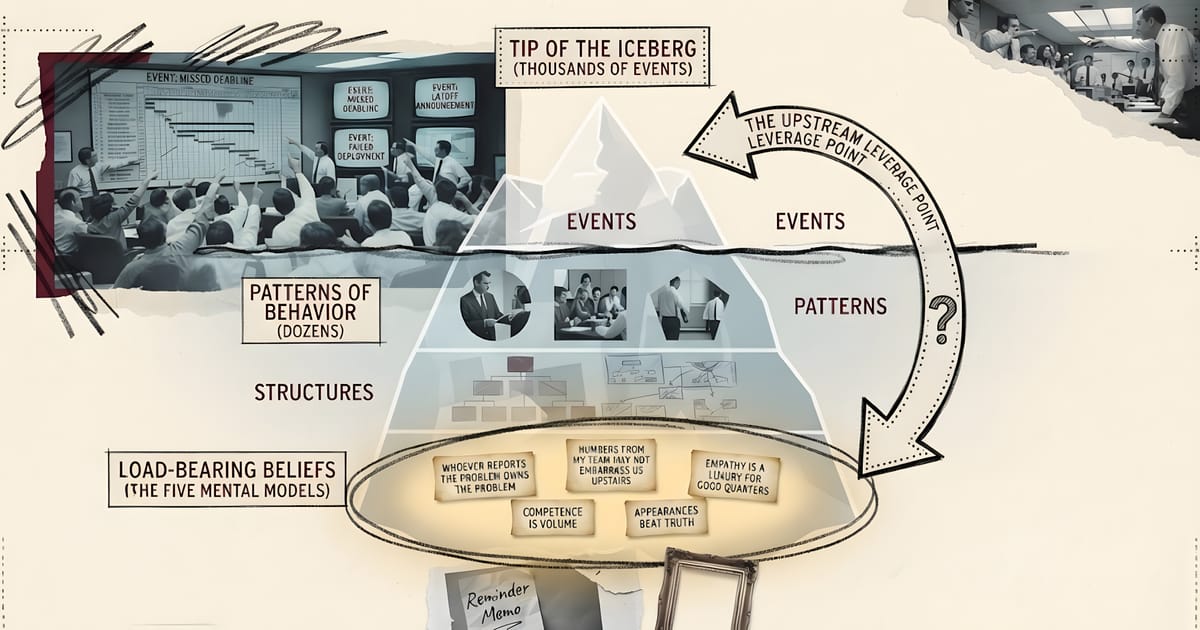
The post-mortem took two hours and produced, at the end of it, an action item. Someone would send a reminder about the thing that had gone wrong. This is how organisations metabolise failure everywhere: the event is reviewed, the event is regretted, and an instruction is issued about events of that type. Then the same failure returns in a new costume - because the meeting spent two hours on the tip of the iceberg and never once looked at the water.
Systems thinkers gave this shape to the world decades ago, and Peter Senge's "The Fifth Discipline" made it travel: above the waterline sit events: the thousands of things that happen, each one a shock, each one demanding a reaction. Below them are patterns: the dozens of behaviours the events keep repeating. Below those, the structures that produce the patterns. And at the very bottom, generating everything above it, a small number of mental models: the beliefs about how the world works that nobody says out loud because nobody can see them. The models sit underwater, load-bearing, invisible.
Now apply the arithmetic, because the arithmetic is the scandal. A company faces thousands of events a year and staffs for events: war rooms, incident reviews, escalation chains. It faces perhaps a few dozen genuine patterns and mostly resents them. But the number of mental models actually generating the mess can be counted on one hand - the handful of beliefs like "whoever reports the problem owns the problem" or "numbers from my team may not embarrass us upstairs" that quietly manufacture all of it. Most of an organisation's chaos is upstream. Most of its energy is spent downstream. That inversion is why the reminder memo is always being written and never working.
The Why Values framework makes a claim that takes this same iceberg and turns it toward a person: your values are the mental models. Not an event-level phenomenon, not the resolution made in January or the reaction to this morning's email; but the small set of beliefs underneath, deciding what counts, what is worth doing, and which good wins when two goods collide. The framework's whole architecture - the dimensions, the drives, the archetypes - is an attempt to draw that bottom layer for one human being instead of one company.
Read this way, the diagnosis explains the cure industry's strange failure rate. Advice is almost always event-shaped: a technique, a habit, a morning routine. It lands on the waterline and is judged, fairly quickly, by whether the events stopped. They do not stop, because the advice was never the layer that was generating them. The person who keeps choosing the wrong boss, the wrong fight, the wrong silence, is not having bad luck at the level of events. Something underneath is doing the choosing, and until it is read, it will keep writing the same story with different characters.
Which is the argument for the unglamorous work. You cannot staff a thousand events. You can read five beliefs. The leverage is not at the waterline, where the weather happens. It is below, where the weather is decided.
Takeaway: Events are thousands, patterns are dozens, and a handful of mental models generates all of it. Most of life's chaos is upstream of values, and most advice is spent downstream - on the tip of the iceberg.