The Cost of Not Knowing What Drives You
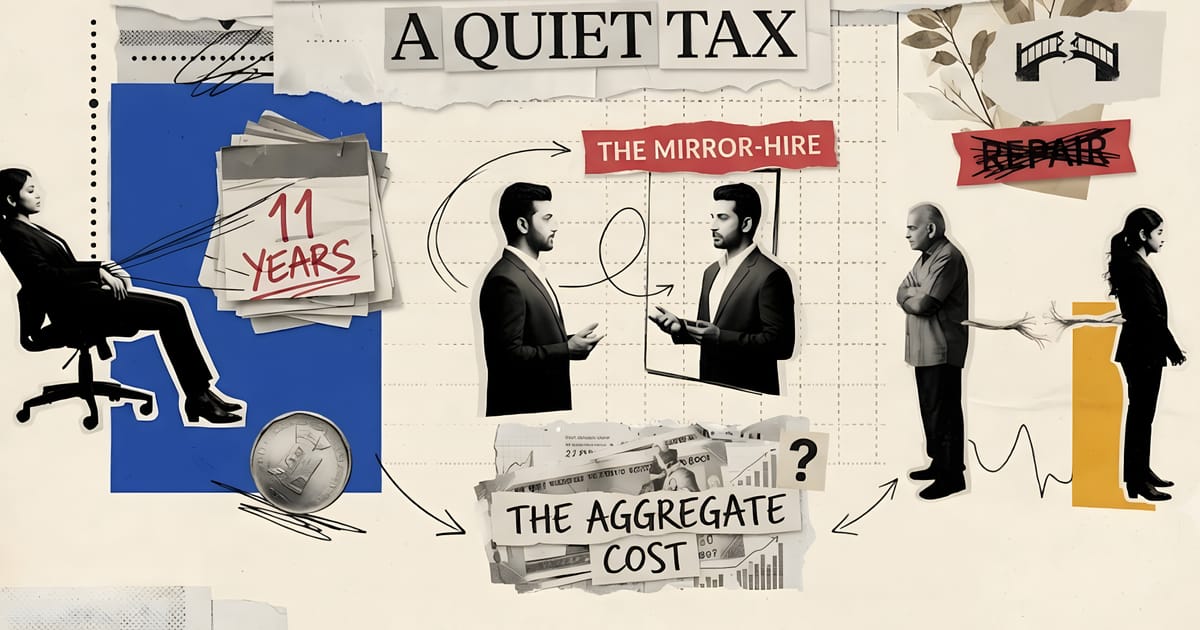
There is a quiet tax paid by people who never mapped what drives them: eleven years in the wrong job, a leadership team of mirror images, the apology that never came. None of these people lacked intelligence or effort - only a map of their own weighting.
There is a price list nobody publishes. Not for the big failures - the bankruptcy, the divorce - but for the quiet tax paid by people who have never mapped what actually drives them. Ask around and you will collect the same entries again and again, told with unusual specificity, as if each narrator had been waiting for permission to confess.
The job stayed in too long. The manager who spent eleven years in a role that stopped fitting at year three. Not for lack of options - for lack of a scoring system. Without knowing his values, every alternative looked like a coin flip, and coin flips favour the incumbent. The research on fit explains the arithmetic he couldn't see: Kristof-Brown's meta-analysis of over 170 studies found that person-organisation fit meaningfully predicts job satisfaction, commitment and intention to stay. Meanwhile Gallup finds only about 23 percent of employees worldwide are engaged at work, and estimates the disengagement bill at $8.9 trillion - roughly 9 percent of global GDP. A large share of that mass is people paying the same tax: staying, unengaged, because they cannot name what would engage them.
The hire hired a mirror. The founder who recruited "people like us" for a decade and built a leadership team that shared her blind spots exactly. She thought she was selecting for excellence. She was selecting for value-congruence with herself - which feels identical in the interview and becomes fatal in the second year, when the room needs exactly the perspective nobody in it has.
The apology never made. The parent whose values ranked pride over repair, and who ran that ranking so unconsciously that the estrangement looked like fate rather than policy. "We were never close," the family says later, as if describing weather.
Notice what these costs have in common: in each case, the person did not lack information, effort, or intelligence. They lacked a map of their own weighting. And ignorance here is not neutral. Nobody says "I had no values at the time" the way they say "I had no data at the time." The unmapped values still voted - confidently, daily, with the full authority of certainty - and the votes were simply never audited.
The encouraging part is that this tax is optional, and the audit is not mysterious. Values mapping does not require therapy or a decade of retreat; it requires an instrument, honesty, and the willingness to be surprised - because if you can predict every result in advance, you are describing your aspirations, not your drivers. Confusion, fear of wrong choices, "is this me?" - these are not personality flaws. They are invoices. You can keep paying them. Or you can read what, exactly, they're for.
One more entry belongs on the price list, and it is the quietest: the second-hand cost. Children raised in a home with unmapped values do not inherit the values - they inherit the voting pattern, the reflex that will one day keep them in the wrong job, mirror-hire their own teams, and swallow their own apologies. The tax compounds across generations with no one signing for it. Map yours and the inheritance changes shape: not a reflex to be endured, but a set of weights, visible, examined, and yours to pass on deliberately.
And it is worth being honest about why the audit keeps getting deferred: the taxes are invisible precisely because they are local. Each decision, examined alone, was defensible. Only the aggregate - eleven years, one hiring pattern, a silent decade - reveals the billing. That is what a map buys you: the aggregate.
Takeaway: Value-illiteracy is not free. It bills you in decades of the wrong job, the mirror-hire, the unmade repair. The mapping is cheaper than the tax.