The Compatibility Test Nobody Runs
Two founders, same mission, same words on the wall - opposite operating systems. One decided by consensus and rewarded empathy; the other decided fast and rewarded the number.
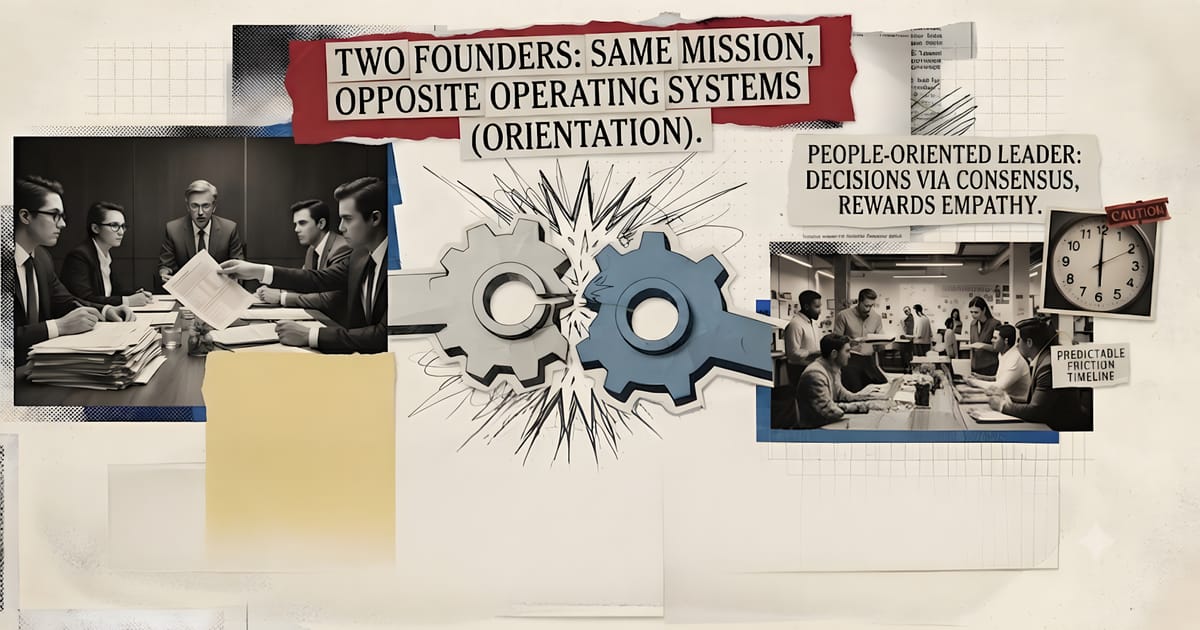
Two founders started companies with the same mission, in the same industry, in the same year. The first made every decision through consensus - hours of it, genuine and unhurried - and rewarded empathy so reliably that people brought their whole selves to work. The second decided fast, sometimes brutally, and rewarded the people who hit the number. Both companies published values that were, word for word, nearly identical. People-first. Results-driven. Integrity in everything. The posters were the same. The operating systems were opposites - and within three years, the two companies hired different people, promoted different behaviours, and lost different customers, all while running the same words on the wall.
Most team design starts with the poster and stops there, which is why most team design fails in the second year. The poster tells you what a company endorses. It tells you nothing about the hierarchy that governs it - which good wins when two good things compete for the same hour. That hierarchy is the value orientation, and a team built without reading it is not a team. It is a directory of individuals who share an office, because orientation is what decides everything the poster can't: how decisions get made, what gets rewarded, which behaviour quietly becomes "how things are done here."
The Why Values framework gives this a working distinction: orientation - the deep, stable ordering of what a person's compass ranks first - and values, the language each of us uses to describe whatever our orientation happens to reward. Two leaders can use the same values vocabulary while running opposite systems, exactly like the two founders: the words matched; the tiebreakers didn't. Read the tiebreakers and the "mystery" of most team friction evaporates.
The research on fit has been measuring this for decades without most hiring processes listening. Kristof-Brown's meta-analysis - over 170 studies - found that person-organisation fit meaningfully predicts job satisfaction, commitment and intention to stay, while person-job fit predicts performance. The finding hiring keeps ignoring is the second-order one: misfit at the orientation level does not produce visible failure. It produces quiet exit. High performers leave without complaining, quote no grievance in the exit interview, and the organisation concludes it has a compensation problem. It has a compass problem, and no salary band fixes a compass.
Which is the compatibility test nobody runs, and it is almost embarrassingly simple to run properly. Before hiring - or pairing, or promoting - map the orientation of the person and the orientation of the team that will receive them. Then ask the only question that matters: does this person's hierarchy survive contact with this team's rewards? The brilliant strategist whose compass ranks deliberation first will not thrive in a founder's office that ranks speed first, no matter how sincerely both sides use the word "excellence." Neither is wrong. They are just two operating systems that will spend the whole relationship arguing about what the word means.
Teams that run this test make different mistakes than teams that don't. They stop hiring "culture fit" as a vibe - the polite word for people who feel familiar - and start hiring orientation fit as a measurement: will this person's compass survive our tiebreakers? The difference shows up in the second year, quietly, in the retention numbers nobody can explain and every exit interview promises to.
Takeaway: Two founders with the same values words ran opposite operating systems - because orientation, not vocabulary, governs. Run the compatibility test before hiring or pairing: does this person's hierarchy survive this team's tiebreakers?