Kylian Mbappe Joins Real Madrid but Refuses to Become the Next Ronaldo
Before Mbappe had played a competitive match for Madrid, football assigned him a biography. His refusal to be the next Ronaldo raises a question about who owns a career's story.
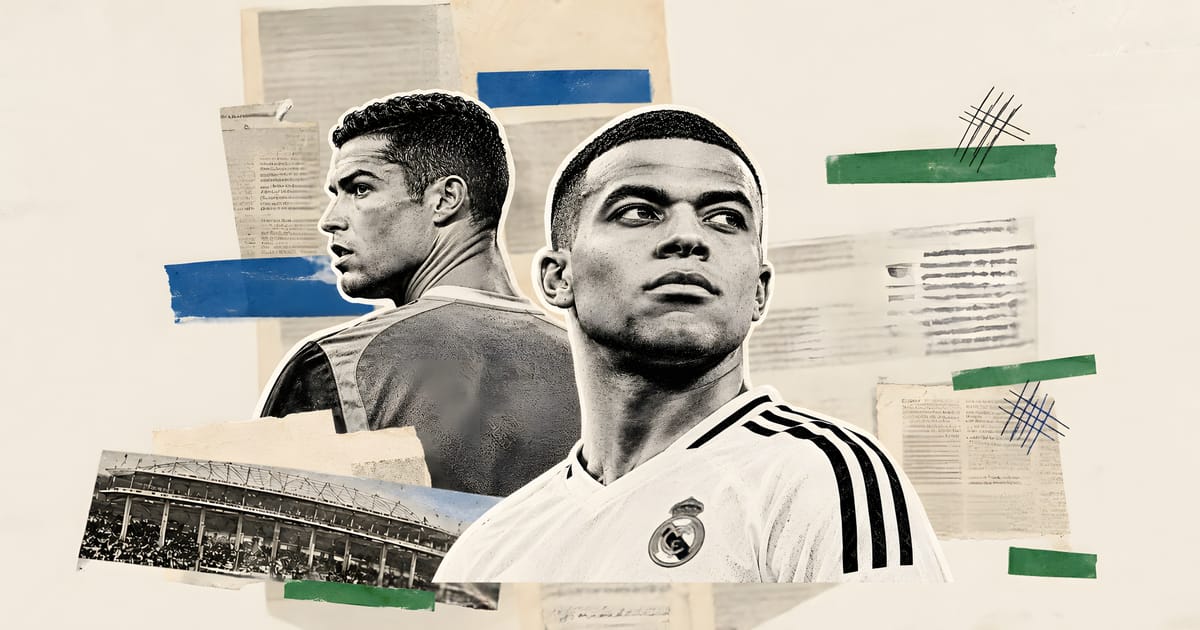
Before Kylian Mbappe had played a competitive match for Real Madrid, someone had already assigned him a biography. He would be the next Cristiano Ronaldo. The destination, the celebrity, the expectation of goals: football had enough familiar material to start writing the sequel.
Mbappe declined the part. Speaking before France's Euro 2024 quarter-final against Portugal, on July 4, he made a distinction that can get lost in the noise around superstar ambition. "I am following my own path," he said. "I'm not going to write the next chapter of Cristiano's story." In Carl Markham's PA report, the refusal sits beside repeated expressions of admiration. Ronaldo had inspired generations. His achievements deserved respect. There would not be another one.
This was no rejection of a hero. It was a negotiation over what admiration entitled other people to demand.
There is an obvious practical explanation. A new arrival gains little by accepting comparisons with a predecessor whose record is already complete. Refusing the comparison can lower the temperature while preserving ambition. It can also be excellent branding: the promise of originality is itself a marketable product. We should keep those readings alive rather than turn a sensible press-conference answer into proof of spiritual independence.
Even so, the distinction matters. In the Why Values framework, self-concept concerns where a person locates the meaning of "I": in individual experience and achievement, or in membership of something larger. Madrid offers both. It is a stage for extraordinary personal distinction and an institution with a history that no signing gets to rewrite from scratch. A player arrives with his own account of who he is; the club and its supporters have an account of who they need him to become.
The second dimension concerns drive: the urge to master an environment and the capacity to receive, adapt and experience it. Mbappe's decision to join such a demanding institution plainly belongs in the territory of ambition. His refusal to inherit someone else's story introduces another consideration: whether the life being pursued will feel like his own.
That is the Warrior and Traveller archetypes in action together, rather than a label for the man. One movement seeks achievement; the other insists that experience and expression cannot be reduced to a ranking. Their adjacent combination, the Athlete, makes the distinction particularly useful. Mastering a craft need not mean allowing its audience to decide what the mastery is for.
In March 2025, Mbappe returned to the argument. Reporting on another France press conference recorded him rejecting the idea of replacing either Ronaldo or Lionel Messi. Scoring more goals in a particular season, he argued, would establish that his season was going well, not that he was greater. The evidential claim was modest and the implication was substantial: a number can measure something without settling everything.
The framework's Authenticity-Inclusion spectrum helps explain the pressure. Authenticity asks whether someone can remain true to an internal experience. Inclusion asks whether the surrounding group can make room for that person without demanding a borrowed identity. Supporters do not have to stop comparing players. But there is a difference between celebrating a tradition and requiring every new talent to reproduce its most successful inhabitant.
There is a blind spot on the player's side too. The Athlete entry identifies dependency on external validation. A declaration of uniqueness does not free anyone from that dependency. "One of a kind" can become another title that needs constant applause. Refusing to be the next Ronaldo could still leave a player performing originality for the same audience that previously demanded resemblance.
The stronger reading of Mbappe's comments is therefore neither heroic nor cynical. He was setting a boundary worth testing over time. Could he accept the discipline and obligations of belonging to Madrid without surrendering the right to experience his career differently? Could the institution accommodate that difference while continuing to demand excellence?
We often discuss sporting succession as if a vacant place and a gifted replacement settle the matter. They do not. A club can inherit trophies, traditions and expectations. A person still has to live the days inside them. Mbappe's refusal was compelling because he accepted the size of the task while questioning who owned the story.