Green Lines and Red Lines: Write Down What's Never Okay
"We have integrity on the wall, and we both know the numbers in this deck would not survive her phone call." Nobody disagreed - that was the problem. A value without written green and red lines is a preference, not a value.
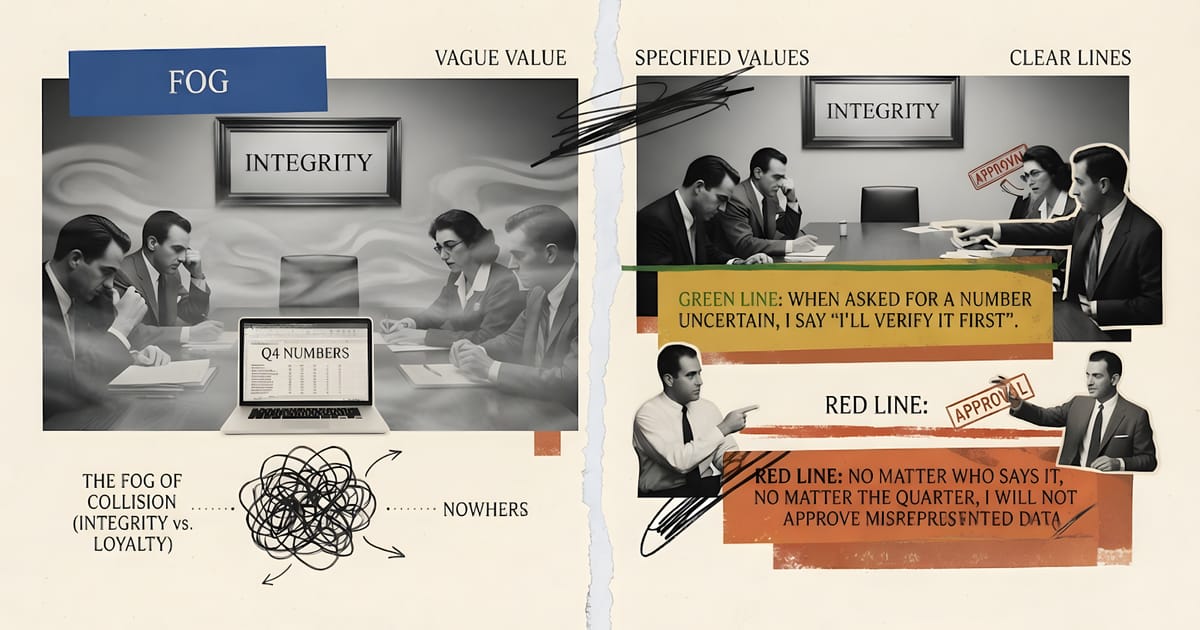
The meeting had been running for forty minutes when the senior woman across the table said it, quietly, in the tone people use for things they have decided not to fight about anymore. "We have integrity on the wall," she said. "And we both know the numbers in this deck would not survive her phone call." Nobody disagreed. That was the problem. Everyone in the room agreed about the value and about the breach, and there was nothing anywhere - no document, no sentence, that connected the two.
This is the standard condition of values in the workplace, and it is not hypocrisy in the way we usually mean it. It is vagueness doing the damage. "Integrity" on a wall is a vocabulary word. It acquires meaning only when somebody specifies what it looks like on an ordinary Tuesday - and what it looks like when it is broken. Most organisations never do the specifying. They assume everyone knows, and then discover, in the meeting where it matters, that everyone knew something different.
The vocabulary for fixing this is older than any consulting framework and simpler. Every value needs two lines written down. A green line: what living this value looks like in behaviour, specific enough that a new joiner could recognise it in their first month. And a red line: what violates it no matter who says it, no matter what it costs, no matter whose quarter it lands in. The green line makes the value trainable. The red line makes the value real - because a value without a stated red line is not a value the organisation holds. It is a value it prefers.
Psychology backs the specification with unusual force. Peter Gollwitzer's work on implementation intentions - decades of studies, summarised across dozens of experiments - found that people who commit to a specific behaviour in a specific situation are dramatically more likely to follow through than people who hold the same intention in general terms. "I want to be honest" changes almost nothing. "When I'm asked for a number I'm not sure of, I say I'll verify it first" changes behaviour measurably. The mind respects the concrete sentence in a way it never respects the noble noun.
The Why Values framework supplies the reason this matters more than it seems. Values, in the framework, are hierarchies - they only order themselves when two good things collide. Integrity collides with loyalty. Speed collides with care. The collision is not the exception; it is the whole test. Which means the worst possible time to define your red lines is during the collision, when the pressures of the moment will define them for you. The lines have to be agreed in calm rooms precisely so they can hold in loud ones.
The value-compass work this comes from began with a client organisation and its own compass exercise, but the tool travels without the setting. Take your team's top three values. For each, write the green line in observable verbs - what would a visitor see? Then write the red line, and make someone uncomfortable: name the version of the violation that comes wrapped in a business justification, because that is the only version that will ever actually occur. Nobody breaks integrity in the shape of a cartoon villain. They break it in the shape of a deck that has to land this quarter.
A team that has done this holds a different kind of meeting. Not a gentler one; the fights get sharper, because the lines give people something to fight with. But the fight is now about the decision instead of about the fog.
Takeaway: A value without written green and red lines is a preference, not a value. Specify what living it looks like and what violating it costs - in calm rooms, so the lines hold when the room goes loud.