Everything Old Is Born Again: What Gatherers, Hunters and the First Farmers Left in You
Watch a product team argue about a feature and you are watching something old: the shipper running a hunt, the blocker farming, the questioner gathering.
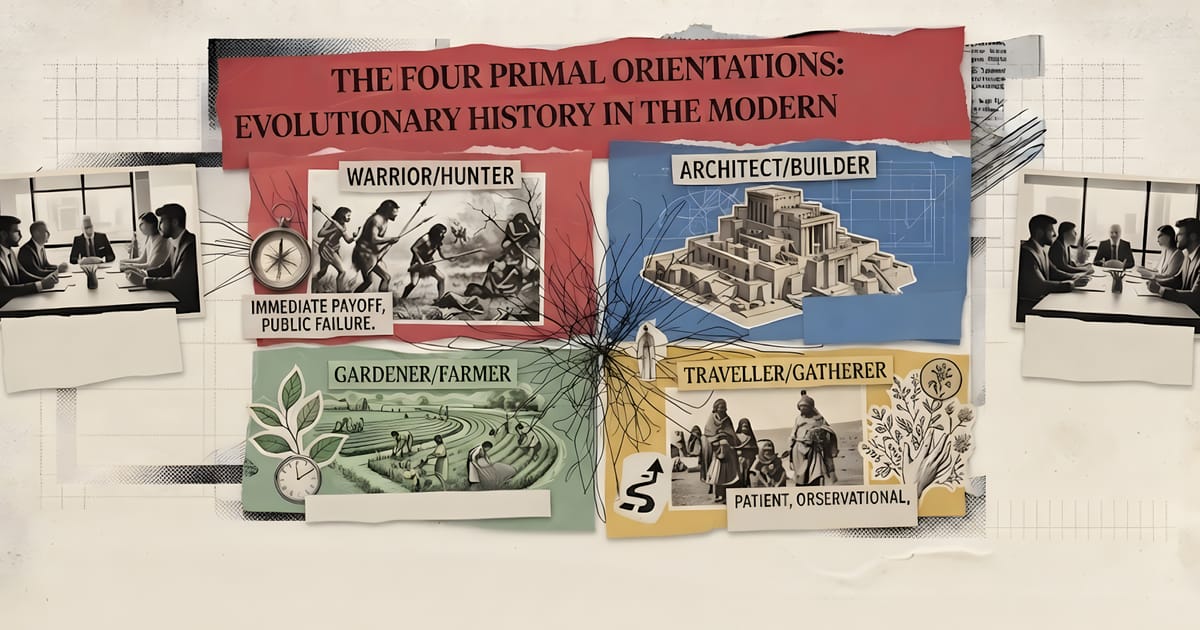
Watch a product team argue about a feature, and you are watching something old. The person pushing to ship the version that works is running a hunt: move, strike, eat. The person blocking to fix the onboarding flow first is farming: protect the field, think in seasons, refuse the fast meal that ruins the harvest. The one who keeps asking what customers actually said, who wants to sit with the raw complaint before anyone optimises it, is gathering - inspecting, sampling, refusing to commit until the ground has been read. Nobody in the meeting chose their stance. Something much older than the meeting did.
The Why Values framework makes a claim most frameworks avoid: its four primal archetypes - the Warrior, the Traveller, the Gardener, the Architect - are not personality inventions of the modern workplace. They reach back through evolutionary history, because the situations that formed them did. For most of the species' run, humans hunted, gathered and then, for the last ten thousand years, farmed and built. Each economy demanded a different relationship with time and risk. The hunter's relationship is immediate: read the terrain, commit fully, accept that the payoff comes in bursts and the failure is public. The gatherer's is patient and observational. The farmer's is cyclical: plan in seasons, invest before the return, live inside delays no hunter would tolerate. And the builder's - the farmer's child, really, grown to scale - is systemic: organise, structure, make the field bigger than one pair of hands.
The evidence that this inheritance survived the office is not subtle. Robin Dunbar's research on human group size found a stable cognitive limit: about 150 people, beyond which we cannot hold relationships - which is why companies beyond that size spontaneously grow hierarchies, rituals and middleware: technologies for a brain that was built for the tribe, running a species that now lives in institutions. The hardware has not shipped an update since. The human you bring to the boardroom is the one that walked out of the savannah, and the boardroom table behaves, to that nervous system, like a fire-lit clearing where rank, threat and alliance are being read exactly as they were ten thousand years ago.
This reframes the vocabulary most people use for their own working life. "I'm not a process person" is not a preference. It is a hunter reporting, accurately, that structures feel like cages. "I need to see it live before I trust the dashboard" is a gatherer's epistemology working correctly in a world that has stopped valuing it. The traveller - the archetype that keeps moving because the moving itself is the point - shows up on every commute and in every job-hopper the economy keeps moralising about, and the moralising misses the mechanism. You are not inventing your orientation. You are inheriting it, and then being evaluated by people who inherited a different one.
None of this means the inheritance is a verdict. The boardroom is not the savannah, and the framework's claim is about origins, not destiny. But there is a specific relief available here that no amount of self-improvement content provides: the friction you feel with the way you work - the hunter forced to farm, the farmer rushed to hunt - is not a personal defect. It is an ancestral tool being used outside its warranty.
Takeaway: The Warrior, Traveller, Gardener and Architect reach back through evolutionary history, and the modern office runs on hardware built for hunting, gathering and farming. You are not inventing your orientation; you are inheriting it.