Declared, Espoused, Lived: The Three Values Your Company Actually Has
Walk into almost any large company and you will pass the wall before you meet a person. The wall has the values on it. But every company runs three value systems - declared, espoused, lived - and most culture work fails because it aims at the first while being graded on the third.
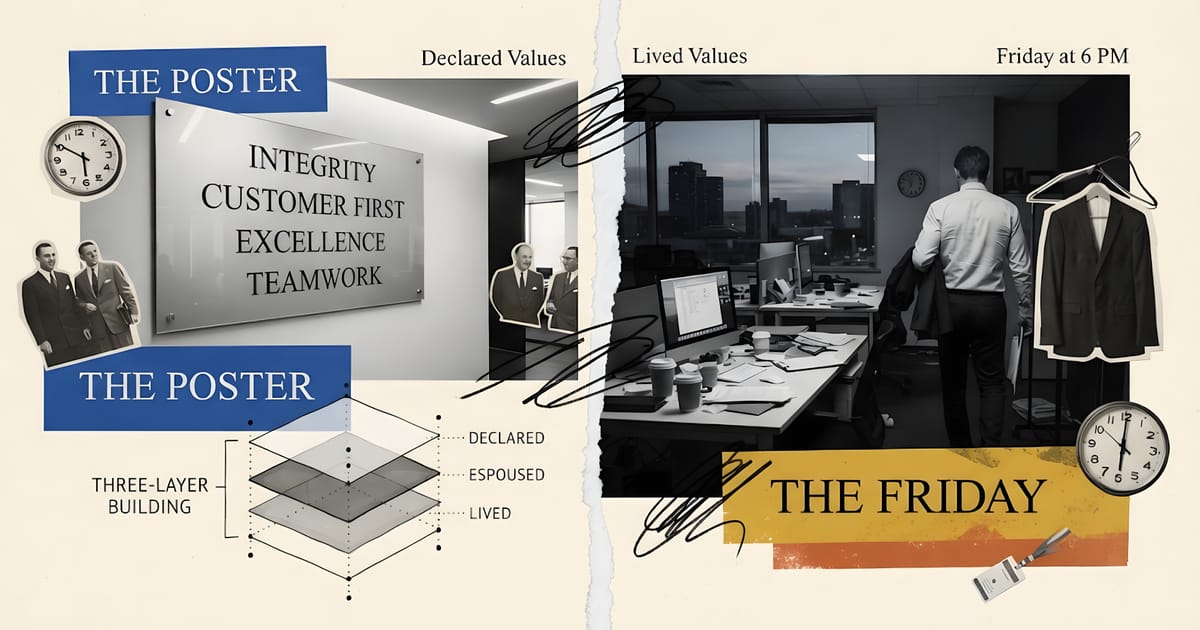
Walk into almost any large company in this country and you will pass the wall before you meet a person. The wall has the values on it. Integrity. Customer first. Excellence. The font is expensive. Somebody in HR spent a quarter choosing the shade of blue.
Now watch the same company on a Friday at six in the evening, and you are watching a different organisation. The meeting that was "aligned" on the call has three private interpretations of the decision. The manager who says "people are our greatest asset" has not had a development conversation with his team all year. Nobody is lying. That is the strange part. Every sentence on the wall was sincere the day it was printed.
Researchers have been tripping over this gap for a long time. The organisational psychologist Chris Argyris built a career on the difference between what he called espoused theories and theories-in-use: the values a person says guide them, and the values you can actually detect in their behaviour when you watch closely enough. His finding, uncomfortable and repeatable, was that the two rarely match, and that most of the people involved have no idea. It is the same reason the most quoted number in change management sits where it does: roughly seven in ten transformation efforts fall short of their goals, and the post-mortems rarely blame the poster.
The reason the gap survives is that most culture projects collapse the three value sets into one. There is the declared set - what is on the wall and in the annual report. There is the espoused set - what the system rewards and wishes were true, which is why the honesty value never survives contact with the manager who shoots messengers. And there is the lived set - what people actually do at six on a Friday, when the audit trail goes quiet. A company that treats these as one thing keeps asking why the training didn't take. The training took. It was aimed at the wrong company.
There is a cleaner way to hold this, and it comes from the Why Values framework itself. A person, in the framework, has a values profile: orientations and drives arranged in a hierarchy that shows itself under pressure. So does a company. The declared profile is the one the company wishes it were. The lived profile is the one an honest observer would score after a month of watching Fridays. The distance between the two profiles is not a communications problem and cannot be fixed with a better poster. It is the single most diagnostic number an organisation owns, and almost nobody measures it.
Because here is what the wall actually is. The wall is a claim about identity, made by an organisation, in public. The behaviour is the organisation's real answer, given in private, daily, at scale. When the two agree, culture feels like a fact. When they disagree, employees do not experience hypocrisy as an abstraction; they experience it as the weather, and they plan their careers around it.
So before the next culture workshop, try the cheaper exercise. Pick one value off the wall. Write down what a person would be seen doing, on an ordinary Tuesday, if the company actually held it. Then go find out who in the building is seen doing it, and what happens to them. You will learn more in an afternoon than a year of surveys will tell you, because the wall tells you what the company says. The Fridays tell you what it is.
Takeaway: Every company runs three value systems - declared, espoused, lived; and most culture work fails because it aims at the first while being graded on the third. The gap between the poster and the Friday is the diagnosis.